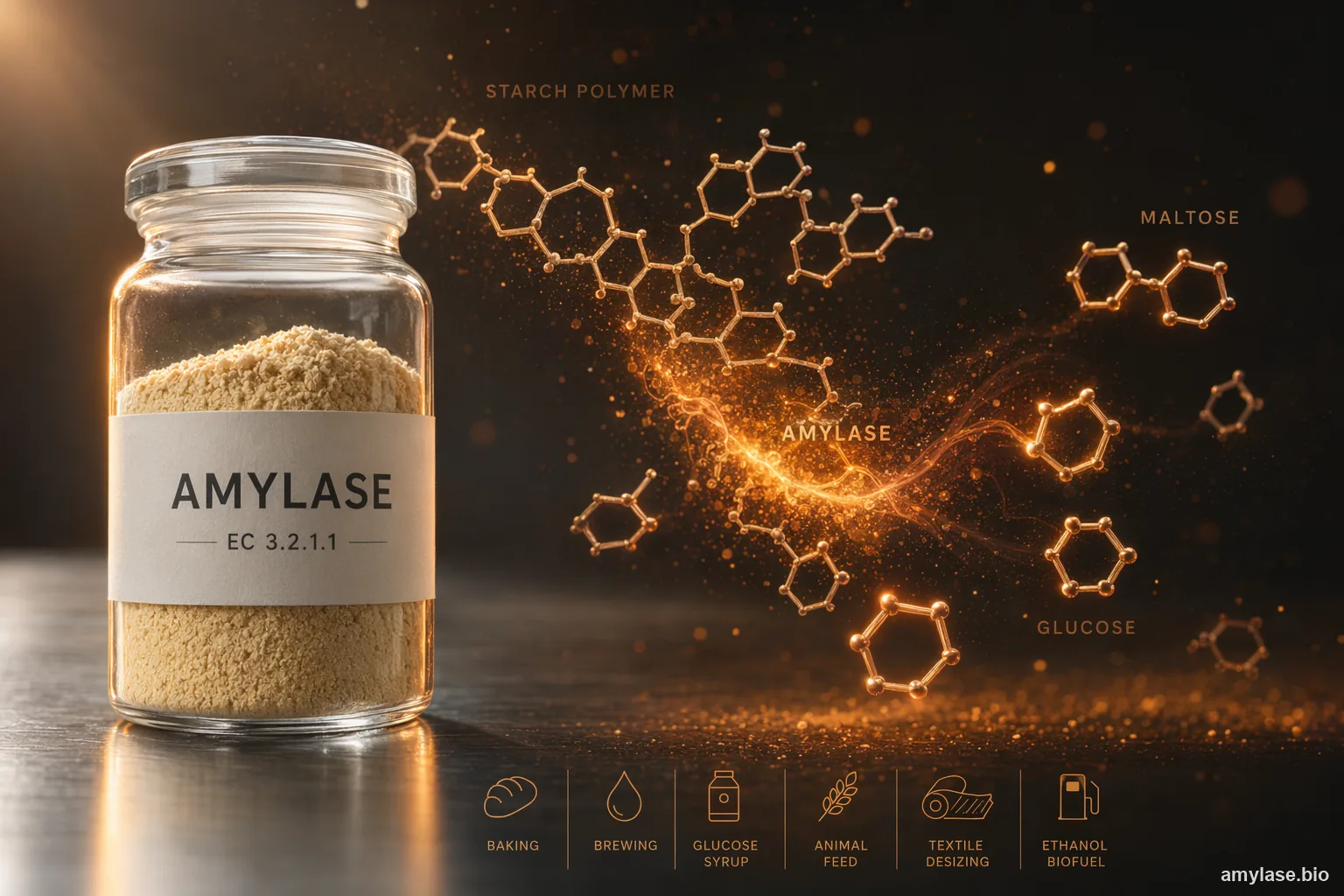
Amylase Enzyme for Animal Feed Digestibility
Feed-grade amylase in bulk for feed mills, premix manufacturers and feed-additive distributors — unlocking starch energy from corn, wheat and barley diets for poultry, swine and aquaculture. Quoted per order.
Young monogastric animals — newly hatched chicks, weaned piglets, juvenile fish — produce insufficient endogenous amylase to fully hydrolyse the starch in grain-based compound feeds. This results in undigested starch passing into the hindgut where it fuels bacterial fermentation, increasing wet litter, digestive stress, and disease pressure, while the available metabolisable energy (ME) from feed falls short of formulation targets. Supplementing feed with exogenous amylase enzyme directly addresses this limitation by initiating starch hydrolysis earlier in the digestive tract, improving glucose release and energy availability.
Our feed-grade amylase enzyme is derived from Aspergillus oryzae (10,000–50,000 U/g) and Bacillus subtilis (50,000–100,000 U/g), covering the pH range encountered in the stomach and small intestine (pH 4.5–7.0) and active across the temperature range relevant to body temperature digestion (37–42°C for poultry, 37–40°C for swine). The enzyme is formulated for pellet stability, withstanding feed conditioning at 75–85°C for 30 seconds, which is the standard conditioning window used in most commercial pellet mills.
For poultry diets based on corn-soy or wheat-based rations, amylase supplementation at 200–500 g/t complete feed has been shown to improve starch digestibility by 3–8 percentage points, translating to a reduction in feed conversion ratio (FCR) of 2–4 points at equivalent live weight gain. In swine starter and grower diets, amylase helps address the pancreatic enzyme deficit in weaned piglets, improving starch digestion coefficient from the small intestine by 5–10 percentage points. Aquaculture feeds, particularly for shrimp and tilapia, also benefit from amylase supplementation where high-starch binders are used.
Feed mills, premix manufacturers and feed-additive distributors buy this amylase in 25 kg fiber drums, quoted per order (MOQ 25 kg). They usually check thermostability at conditioning temperature, declared activity, and compatibility with the other enzymes in a multienzyme blend. We supply TDS, COA, and HALAL and KOSHER certificates per lot. Premix blends can be formulated on request. To request a quote, send the target species, the quantity per order or per year, and the delivery country.
Broiler Poultry Starter and Grower Diets
Corn-soy broiler diets contain 30–40% starch, but newly hatched chicks have limited pancreatic amylase output for the first 10–14 days. Adding feed-grade amylase at 200–400 g/t of complete feed improves starch conversion in the duodenum and jejunum, increasing glucose absorption and available metabolisable energy. This translates to improved daily weight gain and reduced FCR during the critical starter phase when feed efficiency has the largest economic impact.
Weaned Piglet Starter Feeds
Piglets weaned at 21 days have pancreatic enzyme activity well below adult levels for 2–3 weeks post-weaning. Supplementing starter feeds (up to 35% starch as corn or wheat) with amylase at 300–500 g/t complete feed bridges this digestive deficit. Improved starch hydrolysis in the small intestine reduces hindgut fermentation, lowering post-weaning diarrhoea incidence and improving lean gain per unit of feed consumed. Pellet stability at 75–80°C conditioning is a key selection criterion.
Wheat-Based Poultry and Swine Diets
Wheat starch has different granule morphology and digestibility from corn starch. Amylase dosing for wheat-based rations is typically at the higher end of the range (350–500 g/t) to account for both native starch structure and the viscosity-reducing synergy with xylanase in wheat diets. For layers and breeders on wheat-barley rations, amylase helps stabilise ME across variable wheat crop quality, reducing the need to reformulate for each new season's raw material.
Aquaculture Shrimp and Fish Diets
High-starch binders in shrimp pellets (10–25% starch) can be poorly utilised by crustaceans with limited amylase output. Supplementing shrimp starter and grower feeds at 200–400 g/t complete feed improves starch digestion and reduces paste waste in grow-out ponds. For tilapia and catfish diets, amylase supports efficient use of cassava or corn-based starch ingredients, reducing feed cost per kilogram of fish produced. Water-stable pellet formulations require activity retention after pelleting.
| Parameter | Value |
| Activity range | 10,000 – 100,000 U/g (multiple grades) |
| Optimal pH | 4.5 – 7.0 (digestive tract range) |
| Optimal temperature | 37°C – 55°C (feed application optimum) |
| Form | Light yellow to brown powder |
| Shelf life | 12 months (sealed, cool, dry place) |
| Packaging | 25 kg fiber drums |
Frequently Asked Questions
At what dose should amylase be added to animal feed?
Typical inclusion rates are 200–500 g per metric tonne of complete feed, depending on animal species, age, dietary starch level, and target performance improvement. Broiler starter diets benefit from the higher end of this range (300–500 g/t) due to the immature digestive capacity of young chicks. Swine grower and finisher diets with lower starch levels may use 200–300 g/t. Aquaculture feeds vary by species and starch source. Always confirm dosage through controlled feed trials with your nutritionists before commercial rollout.
Will amylase survive feed pelleting at 75–85°C?
Our feed-grade amylase from Bacillus subtilis is formulated to retain activity through standard conditioner temperatures of 75–85°C with 30-second dwell time. Activity retention after pelleting is typically 70–85%, depending on conditioning temperature, moisture, and die pressure. For high-temperature conditioning above 85°C or extended steam exposure, we recommend requesting a thermostable grade and confirming activity retention via in-pellet assay before large-scale production.
Can amylase be blended with xylanase, phytase, or protease?
Yes. Exogenous amylase is commonly used in multienzyme combinations with xylanase (for wheat and barley diets), phytase (for phosphorus release), and protease (for protein digestibility). Enzyme compatibility should be confirmed at the blending stage, and activity declarations should be checked after blending to ensure no significant activity loss. We can supply amylase for blending with your existing enzyme program or assist in formulating a custom multienzyme premix.
What documentation is available for feed-grade amylase?
Each lot is supplied with a Certificate of Analysis (COA) stating declared activity (U/g), moisture, appearance, and microbial limits, plus a Technical Data Sheet (TDS) covering dosage recommendations, storage, and safety. HALAL and KOSHER certificates are available for qualifying orders. Feed manufacturers in export markets may also request ISO 9001 documentation to satisfy buyer audits. We can arrange pre-shipment samples for in-house quality verification before delivery.
Request a Wholesale Feed-Amylase Quote
Send three things: the product or grade (alpha or beta, Aspergillus or Bacillus, powder or liquid), the quantity per order or per year, and the destination country. Add your application and target pH/temperature window if you know them. We'll match the grade, send a free 100 g sample with COA and quote bulk pricing within 24 hours.
Request a QuoteRequest a Wholesale Feed-Amylase Quote
We have received your message. We will reply by email.
Or email hello@mail.amylase.bio