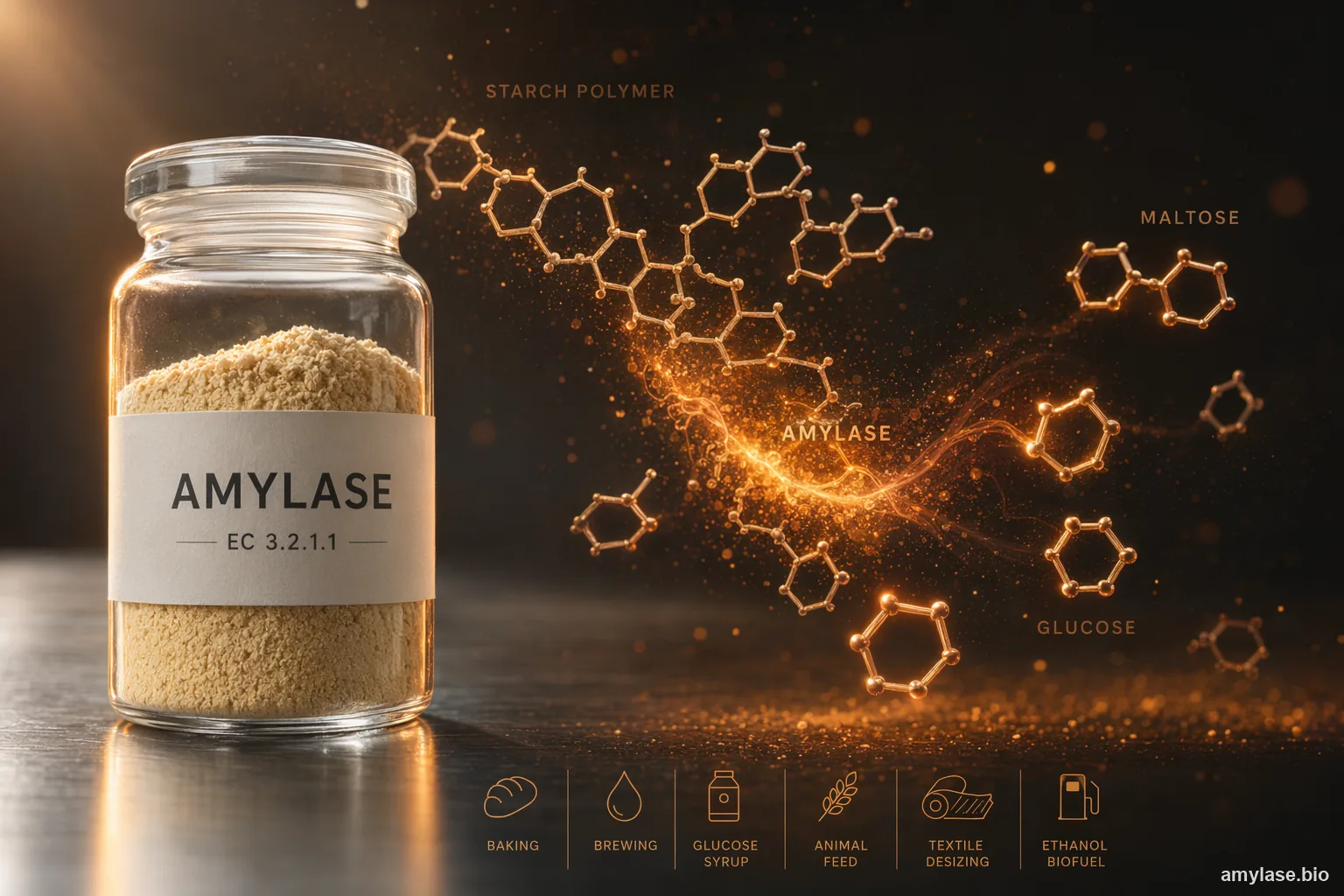
Amylase Enzyme for Glucose Syrup Liquefaction
Bulk thermostable amylase for glucose and fructose syrup producers and ingredient distributors: turns corn and tapioca starch slurry into low-viscosity dextrins at 80–95°C. Quoted per order.
Glucose and fructose syrup manufacture begins with a critical step: liquefaction. Starch slurries at 30–35% dry solids (DS) must be rapidly converted from a thick gelatinised mass into a fluid, pumpable dextrin stream before saccharification can proceed. Amylase enzyme for glucose syrup production is the workhorse of this stage — it cleaves internal α-1,4 glycosidic bonds across the starch molecule, collapsing viscosity and generating soluble dextrins with a dextrose equivalent (DE) of 10–15. Without fast, thermostable activity, jet cookers create unmanageable viscosity, filtration backs up, and downstream glucoamylase yields drop.
Our Bacillus subtilis–derived amylase operates stably at 80–95°C and pH 5.5–6.5, matching standard jet-cook and flash-cool sequences used in corn, wheat, and tapioca starch plants. Calcium ion supplementation (50–100 ppm Ca²⁺) helps maintain thermostability during the holding step. Typical dosage is 0.5–0.8 kg per metric tonne of dry starch, applied at starch slurry preparation before jet cooking. After liquefaction, the DE 10–15 dextrin stream passes to saccharification tanks where glucoamylase and, if needed, pullulanase complete the conversion to high-glucose or high-fructose syrup.
For syrup producers and the distributors who supply them, we quote amylase per order, by the drum, jerrican or pallet. Buyers usually check thermostability at process temperature, consistent lot-to-lot activity, compatibility with existing calcium levels and pH control, and how cleanly the liquefact filters downstream. Powder suits precise batching; liquid suits inline dosing. COA, TDS, ISO 9001, HALAL, and KOSHER documents are available per lot. Minimum order 25 kg, with bulk pallet and container pricing available for continuous syrup production operations. To request a quote, send the starch source, the quantity per order or per month, and the delivery country.
Corn Starch Jet-Cook Liquefaction
Corn starch at 30–35% DS is pre-slurried, pH adjusted to 5.8–6.2, and enzyme dosed at 0.5–0.8 kg/t DS before entering the jet cooker at 105–110°C for a 5-minute hold. The flash-cool to 90–95°C initiates the main liquefaction hold of 60–90 minutes, reducing slurry viscosity from >3,000 mPa·s to below 100 mPa·s and achieving DE 10–15. Calcium ions at 50–100 ppm stabilise enzyme activity throughout.
Tapioca Starch Liquefaction
Tapioca (cassava) starch gelatinises at lower temperatures than corn, requiring careful enzyme staging. Dosage at 0.3–0.6 kg/t DS is typical, with pH 5.5–6.0 and a holding temperature of 85–90°C. The resulting dextrin stream is clearer than corn-based liquefact, making filtration easier. This is especially important for syrup plants targeting high-clarity glucose or HFCS products.
High-Fructose Corn Syrup (HFCS) Feedstock Preparation
HFCS production requires a clean, low-DE dextrin liquefact that feeds glucoamylase saccharification efficiently. Amylase underdosing produces residual starch that fouls glucoamylase columns; overdosing generates excess short dextrins that reduce final glucose purity. Optimal dosing at 0.5–0.7 kg/t DS with 75-minute hold time achieves DE 12–14, the preferred window for HFCS saccharification feedstock.
Continuous Liquefaction Systems
Large-volume syrup plants using continuous liquefaction reactors benefit from liquid amylase formulations that integrate with metering pumps and inline dosing systems. Activity-per-mL specifications allow precise continuous dosing without manual batching. Our liquid grades are supplied in 30 kg jerricans for easy pump connection and maintain activity at the temperature and pH conditions of continuous-flow designs.
| Parameter | Value |
| Activity range | 10,000 – 100,000 U/g (multiple grades) |
| Optimal pH | 5.5 – 6.5 (liquefaction optimum) |
| Optimal temperature | 80°C – 95°C (thermostable grade) |
| Form | Light yellow to brown powder or liquid |
| Shelf life | 12 months (sealed, cool, dry place) |
| Packaging | 25 kg fiber drums / 30 kg jerricans |
Frequently Asked Questions
What is the correct amylase dosage for glucose syrup liquefaction?
Standard dosage for corn or tapioca starch liquefaction is 0.5–0.8 kg of enzyme per metric tonne of dry starch solids, applied before jet cooking. Tapioca may require slightly lower dosage (0.3–0.6 kg/t DS) due to its lower gelatinisation temperature. Final dosage should be confirmed by pilot trial to achieve DE 10–15 at your specific dry solids loading, pH, temperature, and residence time. Overdosing wastes enzyme and increases short dextrin content; underdosing leaves residual starch that impairs downstream saccharification.
Why is calcium important in amylase liquefaction?
Calcium ions (Ca²⁺) are essential cofactors for thermostable alpha-amylase stability. At liquefaction temperatures of 80–95°C, calcium at 50–100 ppm maintains the enzyme's tertiary structure and prevents irreversible denaturation during the holding phase. Most starch plants monitor and correct calcium levels as part of their liquefaction process control. Without adequate calcium, enzyme activity drops prematurely, resulting in incomplete liquefaction and inconsistent DE.
What DE (dextrose equivalent) should liquefaction target?
For glucose and HFCS syrup production, the target DE after liquefaction is typically 10–15. This range provides a dextrin stream fluid enough for pumping and filtration, while still giving glucoamylase sufficient chain length to complete saccharification efficiently. Liquefact DE below 8 may retain too much viscosity; DE above 18 begins to reduce the efficiency of the subsequent glucoamylase step by generating more glucose early. For maltose syrup plants, a different DE target may apply.
Is this amylase food grade and certified for syrup production?
Yes. Our amylase enzyme for glucose syrup production is supplied with food-grade documentation, ISO 9001 quality certification, and HALAL and KOSHER certificates available per lot. COA and TDS are provided with every shipment. For syrup plants supplying food manufacturers or export markets, these documents satisfy standard QA and regulatory review requirements. Non-GMO options are available on request for specific buyer programs.
Request a Bulk Quote for Your Syrup Plant
Send three things: the product or grade (alpha or beta, Aspergillus or Bacillus, powder or liquid), the quantity per order or per year, and the destination country. Add your application and target pH/temperature window if you know them. We'll match the grade, send a free 100 g sample with COA and quote bulk pricing within 24 hours.
Request a QuoteRequest a Bulk Quote for Your Syrup Plant
We have received your message. We will reply by email.
Or email hello@mail.amylase.bio