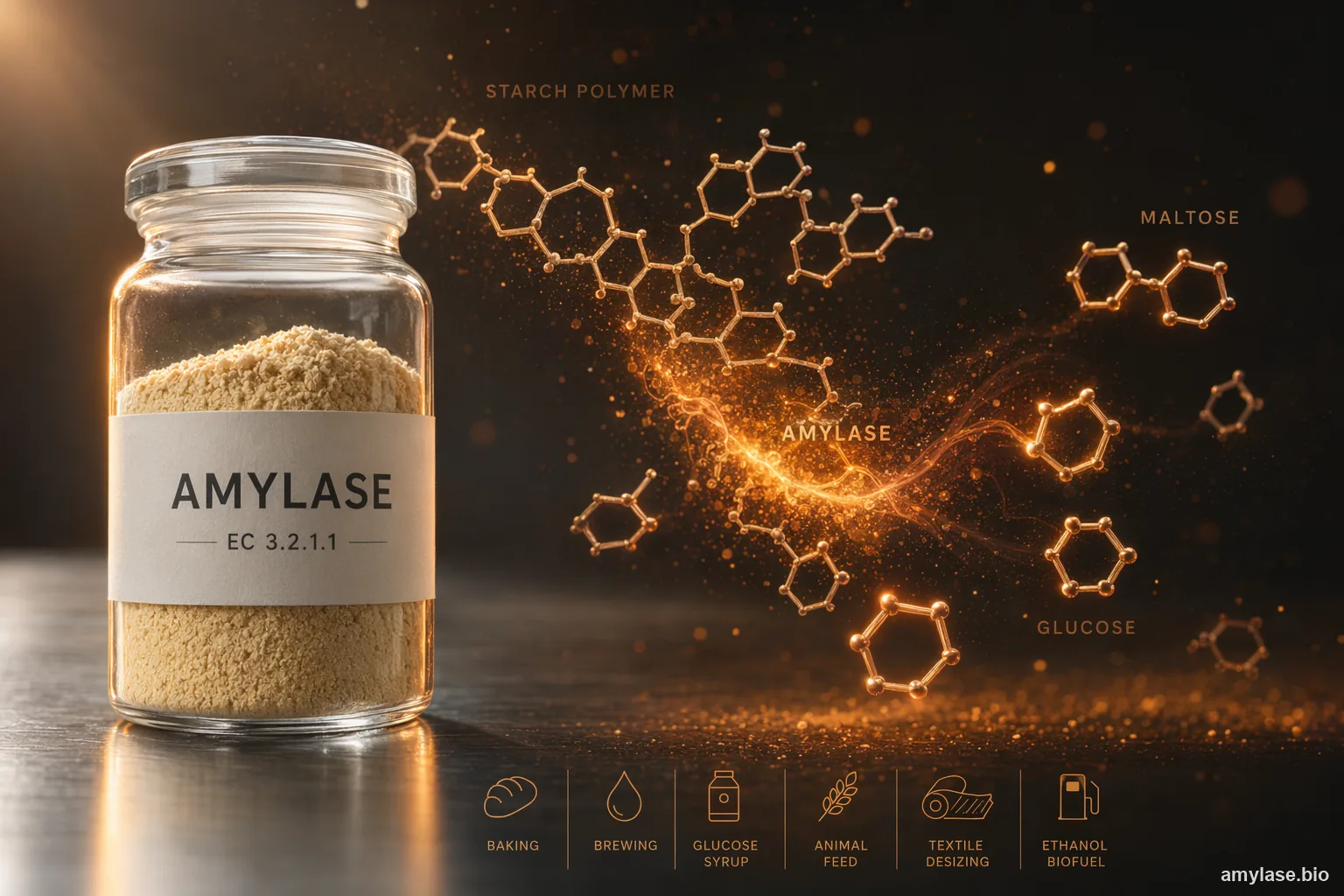
Amylase Enzyme for Textile Desizing
Enzymatic starch removal from woven fabric before dyeing — amylase desizing works selectively on starch size without damaging cellulose fibre or synthetic blends.
Woven fabric cannot be dyed evenly until the starch applied during weaving — the size — is removed. Amylase enzyme textile desizing is the industry-standard method for starch removal because it works selectively: amylase hydrolyses the α-1,4 glycosidic bonds in starch, breaking the size into soluble dextrins and maltose that wash away cleanly, leaving the cotton or polyester-cotton fibre intact. Alkaline oxidative methods that were used historically attack both starch and fibre, increasing tensile loss and requiring more intensive washing stages.
Our amylase for textile desizing is sourced from Aspergillus oryzae and Bacillus subtilis, covering two process windows. The fungal Aspergillus grade operates at 50–65°C and pH 5.5–7.0, suitable for exhaust-batch desizing in jiggers or winches where extended dwell time (60–120 minutes) is available at moderate temperature. The bacterial Bacillus grade extends the upper limit to 80–90°C, enabling pad-steam and continuous range desizing processes used in large-volume fabric preparation. Both grades are supplied in powder or liquid, with liquid grades preferred for inline dosing in pad-batch and pad-steam lines.
Typical dosing in pad-bath systems is 0.3–1.0 g/L enzyme concentration in the pad liquor, with a pickup of 80–100% and a steaming dwell of 10–20 minutes at 100°C, or a batch dwell of 60–120 minutes at 60–70°C. After enzymatic desizing, a hot wash removes the hydrolysed starch residues efficiently, leaving a clean, absorbent fabric surface ready for bleaching or dyeing. The desizing quality is checked by the iodine spot test — a pale yellow or colourless result confirms complete starch removal.
Procurement teams in wet-processing mills evaluate amylase for desizing on activity per gram, thermal range, bath stability, and documentation. We supply COA, TDS, and REACH-relevant material safety documentation per lot. MOQ is 25 kg; bulk quantities are available for continuous desizing ranges.
Pad-Steam Continuous Desizing
In high-volume woven cotton preparation, fabric is padded through the enzyme liquor at 0.5–1.0 g/L, squeezed to 80–100% wet pickup, then steamed at 95–102°C for 15–20 minutes. The steam dwell provides rapid starch hydrolysis across the full fabric width. Bacillus-grade amylase maintains activity during the steam phase, ensuring complete size removal at production speeds without residual starch patches that cause dye spotting.
Exhaust Batch Desizing in Jiggers or Winches
Smaller lots or specialty fabrics are desized in exhaust batch systems at 60–70°C and pH 6.0–7.0 for 60–120 minutes. Aspergillus oryzae–grade amylase is well-suited here, providing good activity in the moderate temperature range without risk of fibre damage. Dosage is typically 0.5–1.5 g/L bath concentration. A subsequent hot wash at 80°C removes hydrolysed starch, and an iodine test confirms complete removal before proceeding.
Polyester-Cotton Blend Desizing
Blended fabrics require enzymatic desizing rather than alkaline methods to protect the polyester component. Amylase selectively targets the starch size without affecting the synthetic fibre, reducing the risk of oligomer precipitation and surface damage. Process conditions are maintained at pH 5.5–7.0 and 60–75°C to balance starch hydrolysis rate with fibre protection. Liquid amylase grades are preferred for accurate dosing in automated dispensing systems.
Cold Pad-Batch Desizing
For mills with long dwell time available, cold pad-batch desizing at room temperature with a dwell of 8–16 hours is an energy-efficient option. Specialised cold-active amylase grades at doses of 2–5 g/L are applied, and the batched fabric is covered and held overnight. This method reduces steam energy costs and is suitable for lightweight woven fabrics where high-temperature treatment poses dimensional stability risks.
| Parameter | Value |
| Activity range | 10,000 – 100,000 U/g (multiple grades) |
| Optimal pH | 5.5 – 7.0 |
| Optimal temperature | 55°C – 90°C (grade dependent) |
| Form | Light yellow to brown powder or liquid |
| Shelf life | 12 months (sealed, cool, dry place) |
| Packaging | 25 kg fiber drums / 30 kg jerricans |
Frequently Asked Questions
How does amylase enzyme remove starch size from fabric?
Amylase hydrolyses the α-1,4 glycosidic bonds in starch, breaking the continuous starch film into small, water-soluble dextrin fragments. These fragments are then removed in the subsequent wash bath. Unlike alkaline or oxidative methods, amylase acts specifically on starch — it does not attack cellulose, polyester, or other synthetic fibres. This selectivity results in better fabric tensile strength retention and lower effluent chemical oxygen demand compared to oxidative desizing.
What is the recommended amylase concentration in the desizing bath?
In pad-steam systems, 0.3–1.0 g/L enzyme in the pad liquor with 80–100% wet pickup and 15–20 minutes steam dwell at 95–102°C is typical. In exhaust batch systems (jiggers, winches), 0.5–1.5 g/L at 60–70°C for 60–120 minutes is standard. Cold pad-batch desizing at room temperature requires higher dosage (2–5 g/L) with an 8–16 hour dwell. Actual dosage should be confirmed by iodine spot test on trial fabric before full production runs.
How do I verify that desizing is complete?
The iodine spot test is the standard method. Apply a drop of iodine solution (0.1 N) to the washed fabric. Residual starch turns deep blue-black; partial hydrolysis gives a blue-grey tint; complete desizing yields a pale yellow or straw colour. Most mills target a light yellow-cream result before moving fabric to bleaching or dyeing. Regular spot testing across the fabric width catches uneven desizing before it causes dye uniformity issues.
Which amylase grade is better for pad-steam versus batch desizing?
Pad-steam desizing at 95–102°C favours the Bacillus subtilis bacterial grade, which retains activity at higher temperatures for the brief steam exposure. Exhaust batch desizing at 60–70°C is well-served by either Aspergillus oryzae (fungal) or Bacillus subtilis grades. If your mill runs both systems, a mid-range bacterial grade at 70–75°C covers both processes, simplifying inventory. Contact us for grade recommendations based on your fabric type and machine setup.
Request Amylase for Your Desizing Line
Send three things: the product or grade (alpha or beta, Aspergillus or Bacillus, powder or liquid), the quantity per order or per year, and the destination country. Add your application and target pH/temperature window if you know them. We'll match the grade, send a free 100 g sample with COA and quote bulk pricing within 24 hours.
Request a QuoteRequest Amylase for Your Desizing Line
We have received your message. We will reply by email.
Or email hello@mail.amylase.bio