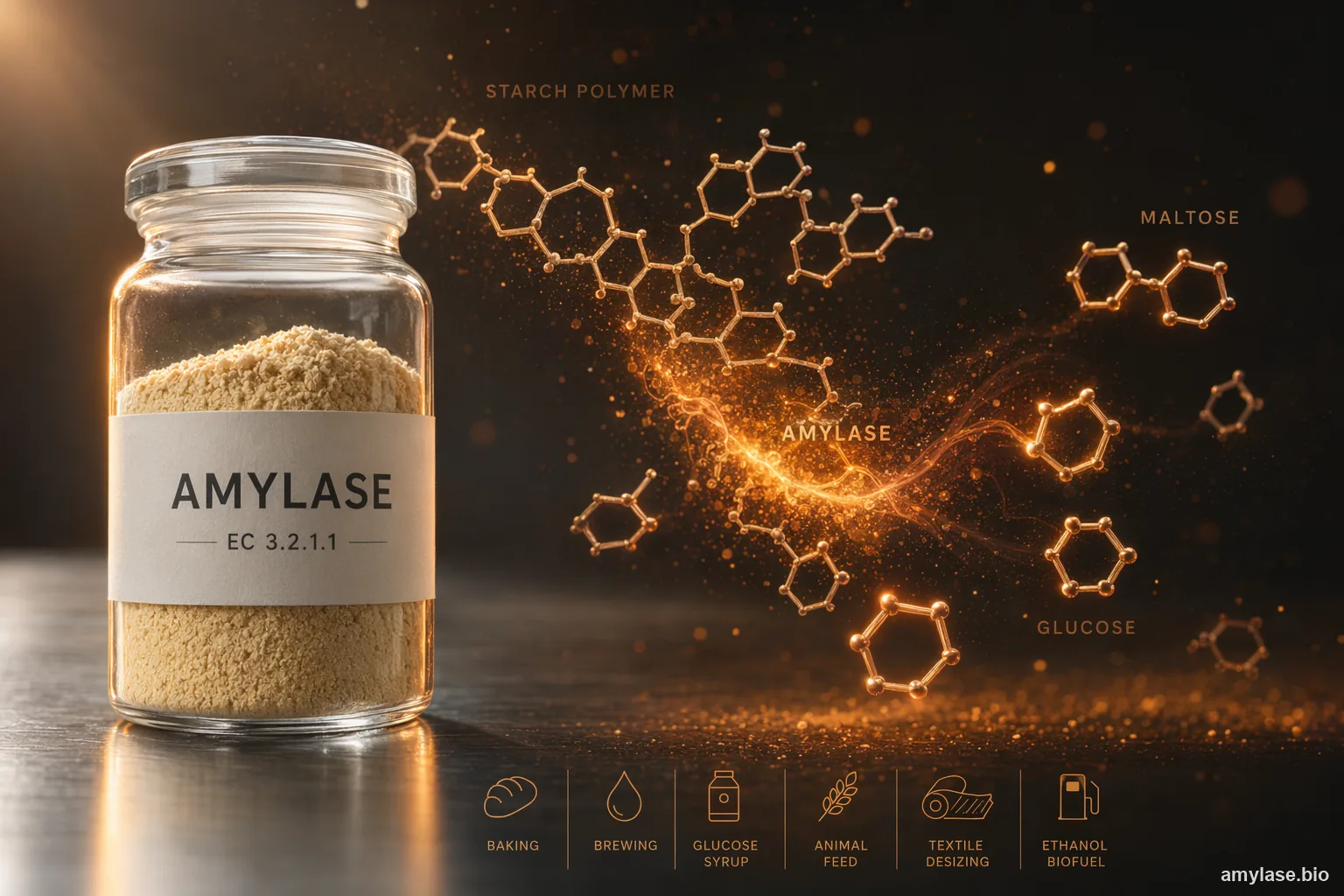
Amylase Enzyme Distilling: Industrial Process Guide
Select industrial amylase for distilling starch conversion with pH, temperature, dosage, QC, pilot validation, and supplier guidance.
A practical guide for distilleries and starch processors selecting industrial amylase enzyme for liquefaction, saccharification support, yield consistency, and cost-in-use control.
Role of Amylase in Distilling Starch Conversion
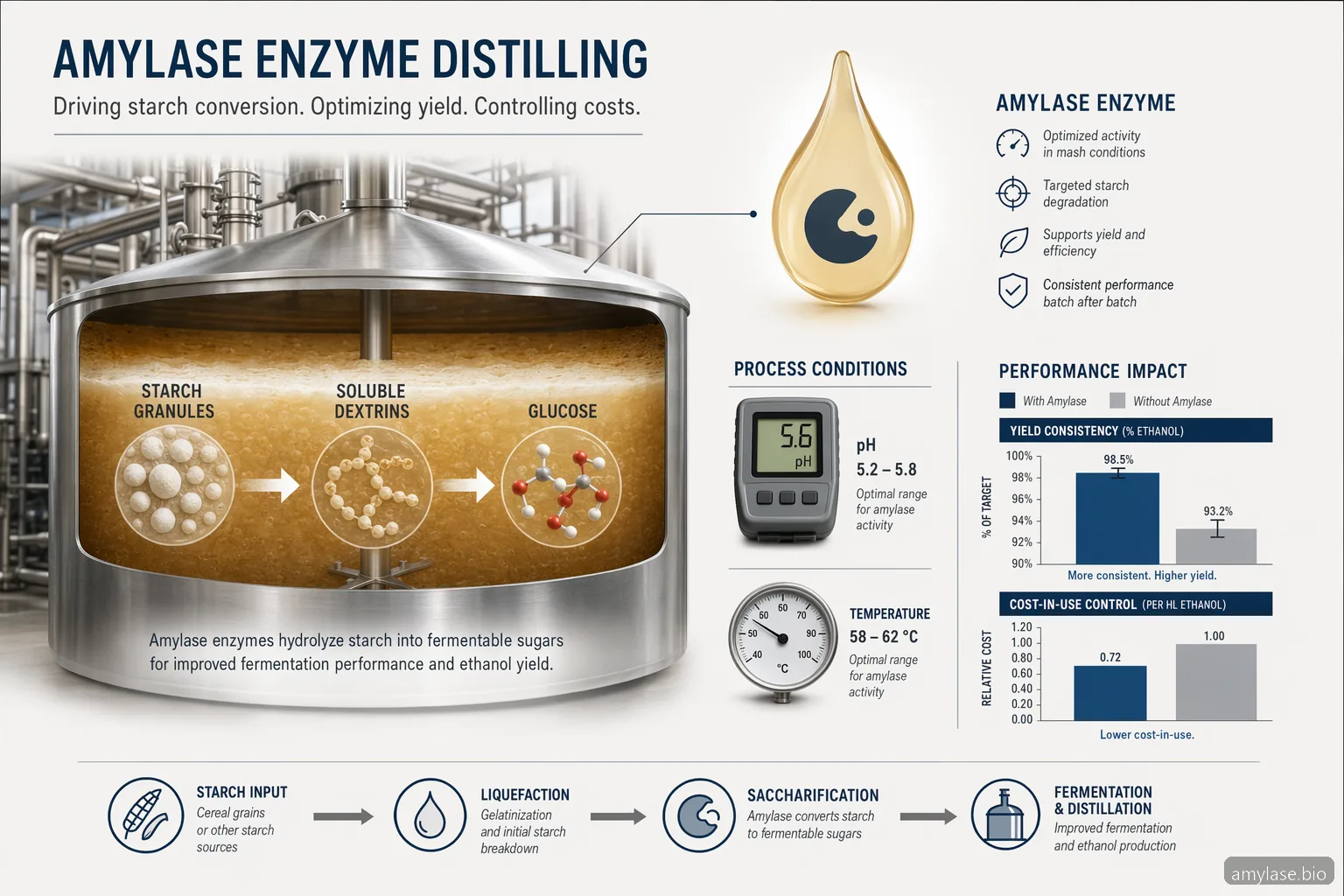
Amylase enzyme distilling applications focus on converting starch-rich raw materials into fermentable sugar streams. In grain, cassava, potato, or other starch mashes, the substrate of the enzyme amylase is starch, specifically amylose and amylopectin. Alpha amylase enzyme cleaves internal alpha-1,4 glycosidic bonds, rapidly lowering viscosity during liquefaction and creating shorter dextrins for further hydrolysis. This is different from consumer discussions of amylase digestive enzyme use; industrial buyers need controlled activity, batch repeatability, and process compatibility. Baking, brewing, biofuel, and paper applications also use enzymes and amylase, but distilling requires particular attention to mash solids, thermal stability, fermentation compatibility, and coproduct impact. A qualified amylase supplier should help define whether a thermostable liquefaction enzyme, a saccharification-support blend, or a combined process approach best fits the plant objective.
Primary function: viscosity reduction and dextrin formation • Main substrate: gelatinized starch in the mash • Common use point: liquefaction or high-temperature cook stage
Recommended Process Conditions
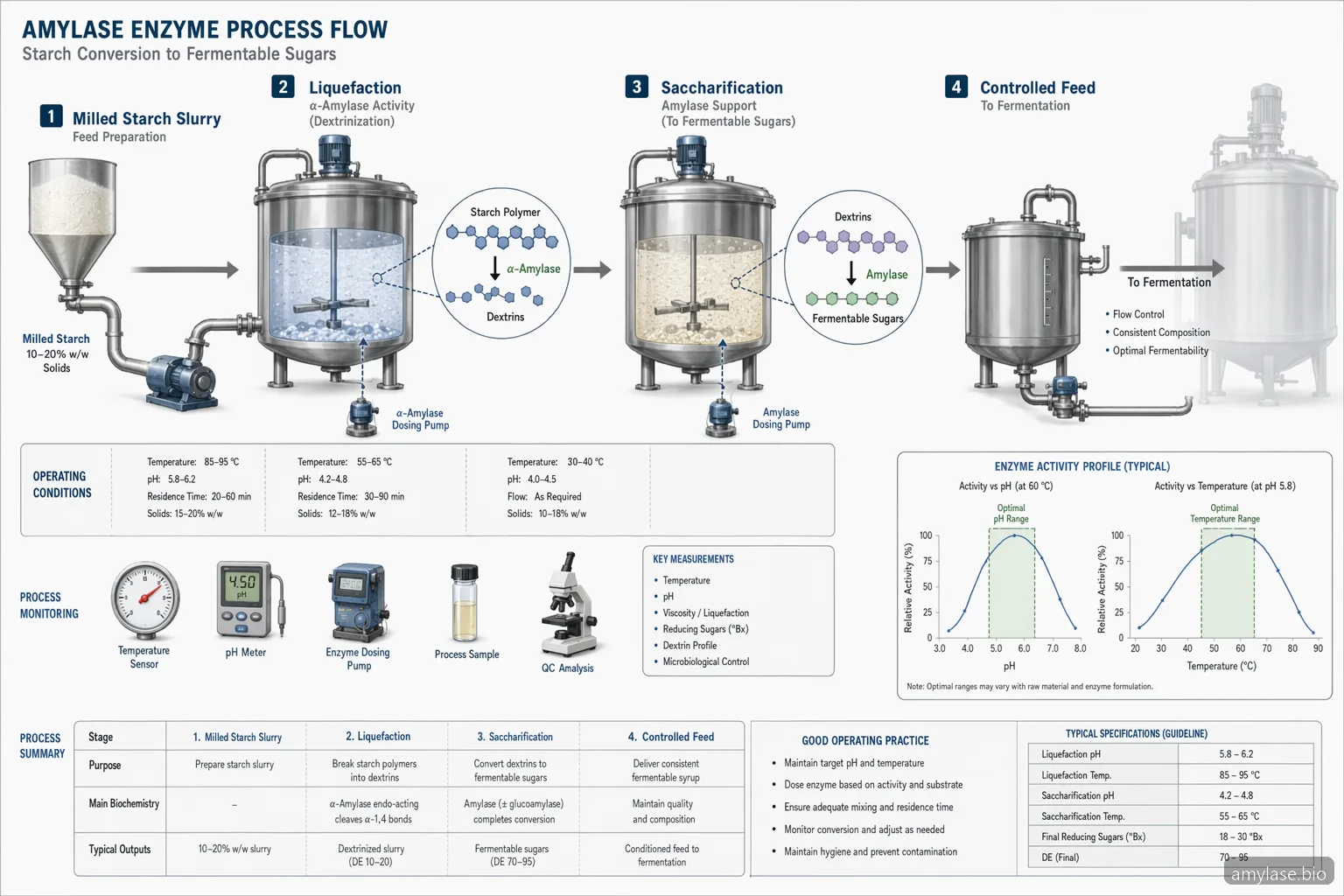
Typical industrial amylase operating windows depend on the enzyme source, formulation, and mash design, so the supplier TDS should be the controlling document. As a starting point, many thermostable alpha amylase products are evaluated around pH 5.2 to 6.2 and 85 to 105 degrees Celsius during liquefaction, often with 30 to 120 minutes of contact time. Lower-temperature enzyme amylase options may be tested near 55 to 75 degrees Celsius where plants use reduced-cook processes. Some products require calcium ions for stability, while others are engineered or formulated for low-calcium systems. Because raw material variability can shift viscosity, dextrose equivalent, and residual starch, plants should validate conditions across representative incoming grain or starch lots rather than relying on a single lab result.
Pilot pH range: 5.2 to 6.2 for many liquefaction trials • Thermostable trial range: 85 to 105 degrees Celsius • Reduced-cook trial range: 55 to 75 degrees Celsius • Confirm calcium requirements before scale-up
Dosage Strategy and Cost-in-Use
Dosage should be established by activity units and process performance, not only by liquid volume or powder weight. A common pilot screening band for industrial amylase is 0.02% to 0.20% w/w on dry starch or grain equivalent, but the correct range depends on enzyme activity, substrate quality, solids level, retention time, and target viscosity. Start with a supplier-recommended midpoint, then run dose-response tests at low, target, and high rates. Track mash viscosity, iodine response, dextrose equivalent, residual starch, fermentable sugar profile, fermentation rate, alcohol yield, and stillage behavior. The lowest dose is not always the lowest cost option if it slows throughput or increases residual starch. Cost-in-use should include enzyme price, dosing accuracy, energy demand, batch time, ethanol or spirit yield, cleaning burden, and process variability.
Suggested pilot band: 0.02% to 0.20% on dry starch basis • Compare dosage by activity units, not package size • Use dose-response data to avoid underdosing and overdosing
Quality Control, Documentation, and Handling
A reliable amylase supplier should provide a current Certificate of Analysis, Technical Data Sheet, and Safety Data Sheet for each commercial enzyme amylase lot. The COA should identify product name, lot number, declared activity, test method reference, appearance, and relevant microbiological or contaminant limits when applicable. The TDS should state recommended pH, temperature, dosage guidance, stability notes, storage conditions, shelf life, and any need for cofactors such as calcium. The SDS should cover safe handling, spill response, personal protective equipment, and respiratory sensitization precautions common to enzyme preparations. Incoming QC can include visual inspection, lot verification, storage temperature review, retained samples, and periodic activity confirmation. Plants should also monitor dosing pump calibration and mixing performance because inaccurate feed can mimic enzyme quality problems.
Request COA, TDS, and SDS before purchase approval • Verify lot number and declared activity at receiving • Store according to supplier temperature and shelf-life guidance • Calibrate dosing systems on a defined schedule
Pilot Validation and Supplier Qualification
Before changing an industrial amylase in commercial production, run a structured pilot validation using plant-relevant mash solids, water chemistry, cook profile, and fermentation organisms. Compare the incumbent and candidate enzymes under identical conditions, then confirm results in a controlled production trial. Supplier qualification should assess manufacturing consistency, lot traceability, technical support, lead time, packaging options, change notification practices, and ability to support troubleshooting. Ask how activity is measured, whether formulation changes are communicated, and what storage excursions may do to performance. For multinational or multi-site plants, confirm that the same product specification can be supplied across regions. The best amylase enzyme distilling selection is the one that delivers repeatable conversion, manageable handling, documented safety information, and measurable economic benefit under actual plant constraints.
Run bench, pilot, and controlled plant trials • Use the same raw material lot when comparing suppliers • Confirm change notification and traceability expectations • Score suppliers on service, logistics, documentation, and performance
Technical Buying Checklist
Buyer Questions
Yes. Is amylase an enzyme is a common basic question, and in distilling the answer is important commercially: amylase is used to hydrolyze starch into shorter dextrins and sugars that can support fermentation. Industrial distillers usually use alpha amylase enzyme during liquefaction, then may use additional enzymes depending on the desired sugar profile, raw material, and process design.
What is the substrate of the enzyme amylase depends on context, but for distilling it is primarily starch in the mash. Amylase acts on amylose and amylopectin after starch gelatinization, reducing viscosity and forming dextrins. In industrial trials, substrate quality, particle size, gelatinization, solids concentration, and water chemistry all affect the observed performance of the enzyme amylase.
Compare suppliers with a structured trial, not only a price quote. Request COA, TDS, SDS, declared activity, activity method, storage requirements, and lot traceability. Run dose-response trials using the same feedstock and process conditions. Then evaluate conversion, fermentation impact, dosing practicality, lead time, technical support, change notification, and total cost-in-use before qualifying a supplier.
The small intestine produces amylase protease and which other enzyme is a digestive biology query often answered with lipase and other intestinal enzymes. For this B2B page, the relevant distinction is that an amylase digestive enzyme discussion is not the same as industrial amylase selection. Distilling buyers should focus on process pH, temperature, activity, safety documentation, and plant validation.
Some amylase enzyme families are used across baking, brewing, biofuel, paper, and distilling, but the formulation and performance target differ. Baking may emphasize dough handling, crumb softness, or fermentation support, while distilling emphasizes mash viscosity, starch conversion, fermentable sugar formation, and yield. Always use the TDS and pilot validation to confirm suitability for the specific application.
Amylase (General-Purpose)
ISO 9001 · Food Grade · HALAL · KOSHER
Frequently Asked Questions
Is amylase an enzyme used in distilling?
Yes. Is amylase an enzyme is a common basic question, and in distilling the answer is important commercially: amylase is used to hydrolyze starch into shorter dextrins and sugars that can support fermentation. Industrial distillers usually use alpha amylase enzyme during liquefaction, then may use additional enzymes depending on the desired sugar profile, raw material, and process design.
What is the substrate of the enzyme amylase?
What is the substrate of the enzyme amylase depends on context, but for distilling it is primarily starch in the mash. Amylase acts on amylose and amylopectin after starch gelatinization, reducing viscosity and forming dextrins. In industrial trials, substrate quality, particle size, gelatinization, solids concentration, and water chemistry all affect the observed performance of the enzyme amylase.
How should a distillery compare industrial amylase suppliers?
Compare suppliers with a structured trial, not only a price quote. Request COA, TDS, SDS, declared activity, activity method, storage requirements, and lot traceability. Run dose-response trials using the same feedstock and process conditions. Then evaluate conversion, fermentation impact, dosing practicality, lead time, technical support, change notification, and total cost-in-use before qualifying a supplier.
Can the same amylase enzyme be used in baking and distilling?
Some amylase enzyme families are used across baking, brewing, biofuel, paper, and distilling, but the formulation and performance target differ. Baking may emphasize dough handling, crumb softness, or fermentation support, while distilling emphasizes mash viscosity, starch conversion, fermentable sugar formation, and yield. Always use the TDS and pilot validation to confirm suitability for the specific application.
Related: Amylase Enzyme for Glucose Syrup Liquefaction
Turn This Guide Into a Supplier Brief Request a distilling amylase evaluation pack with COA, TDS, SDS, dosage guidance, and pilot-trial support. See our application page for Amylase Enzyme for Glucose Syrup Liquefaction at /applications/amylase-glucose-syrup-liquefaction/ for specs, MOQ, and a free 50 g sample.
Contact →