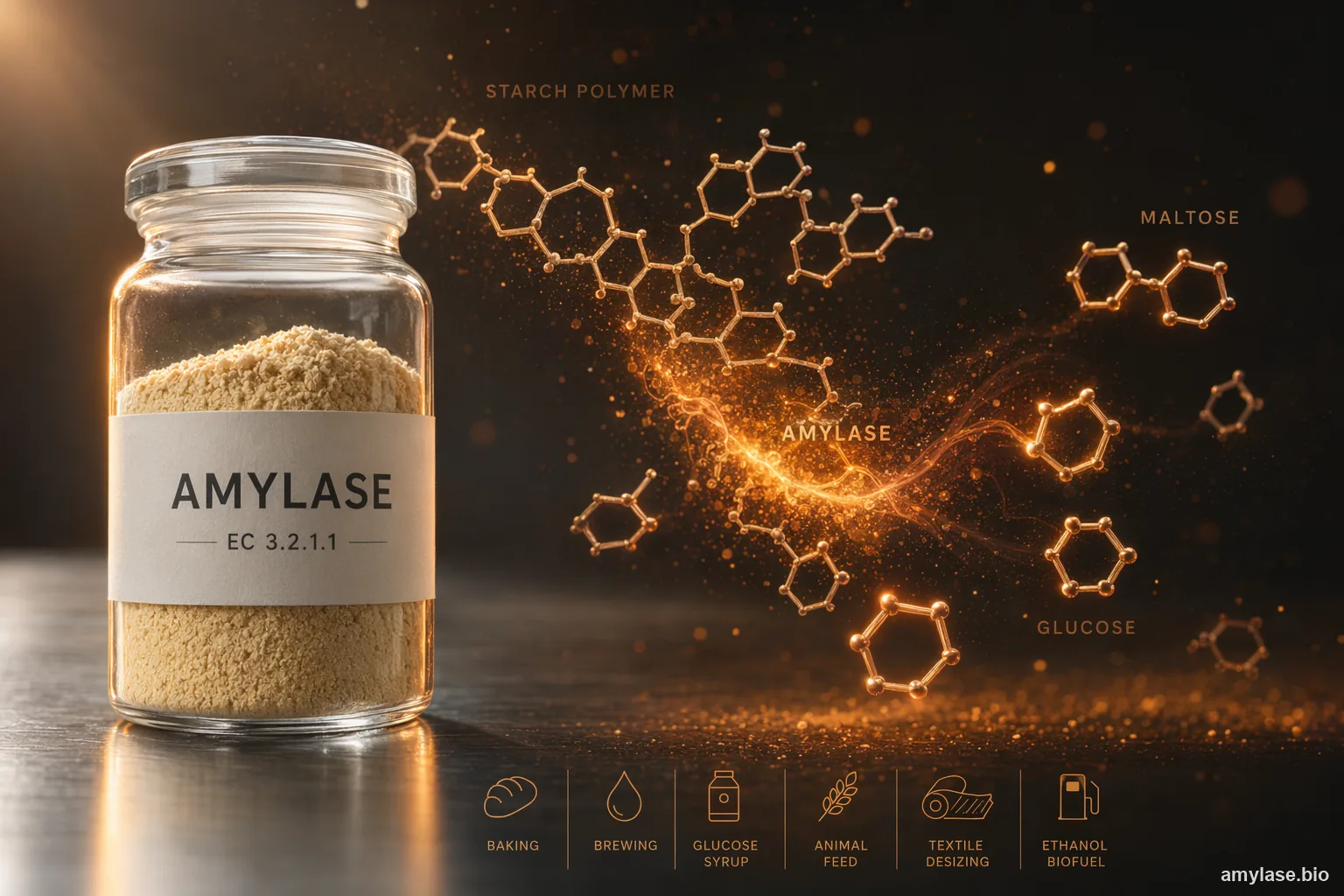
Amylase Enzyme for Baking: Industrial Supplier Guide
Source baking-grade amylase enzyme with practical dosage, pH, temperature, QC, COA/TDS/SDS, pilot validation, and supplier checks.
A practical B2B guide for bakeries, premix manufacturers, and flour improvers evaluating amylase enzyme for consistent dough handling, fermentation, loaf volume, crust color, and crumb softness.
Why Bakeries Use Amylase Enzyme
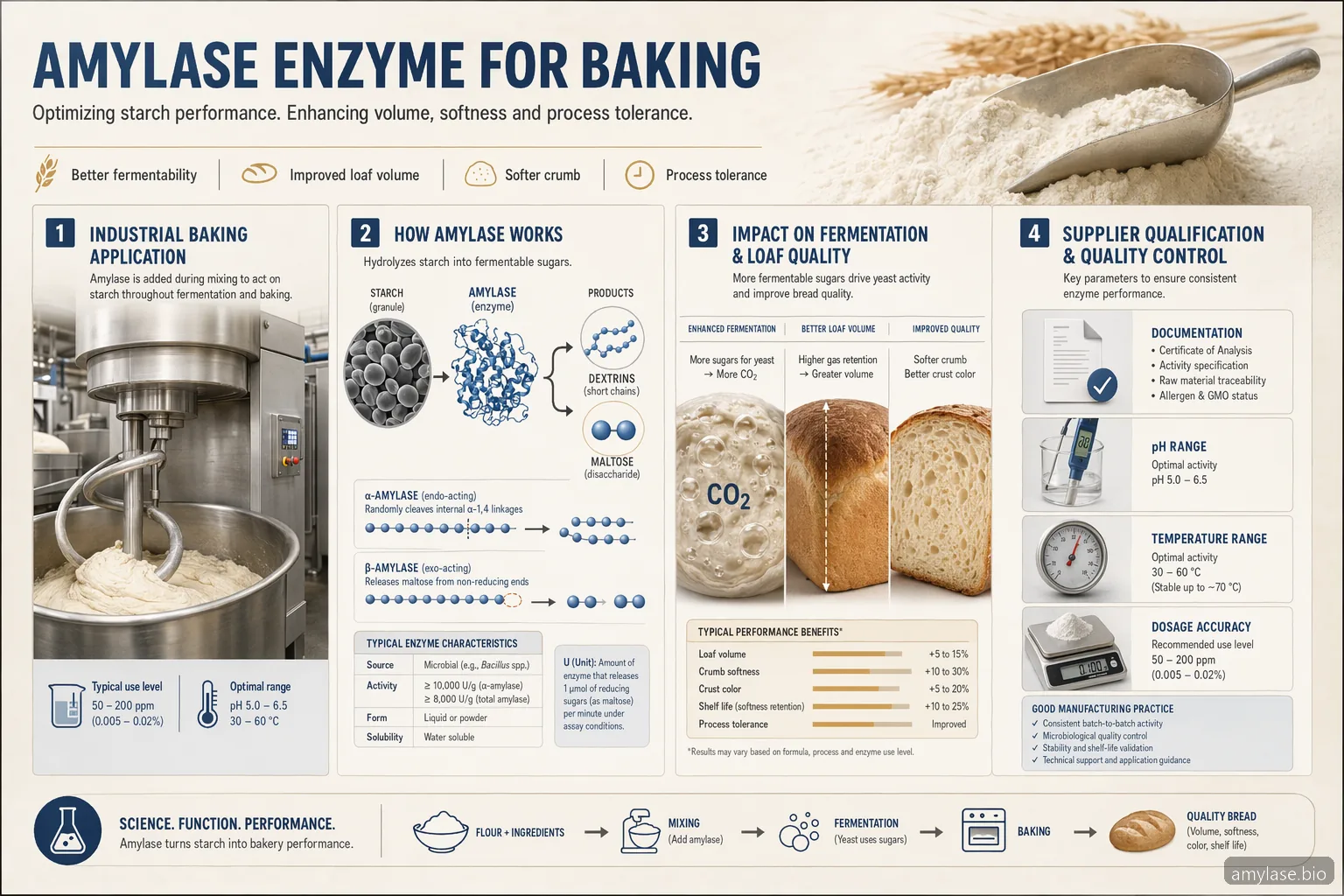
Amylase enzyme for baking is used to standardize flour performance and improve fermentation efficiency. In wheat flour systems, the enzyme amylase hydrolyzes starch, especially damaged starch, into smaller dextrins and sugars that yeast can metabolize. This supports gas production, dough expansion, oven spring, crust browning, and eating quality. For industrial bakeries, the goal is not maximum starch breakdown; it is controlled conversion matched to flour ash, falling number, damaged starch level, formula sugar, proof time, and bake conditions. Too little activity can lead to pale crust and low volume, while excessive activity may create sticky dough, gummy crumb, or weak sliceability. Baking-grade alpha amylase enzyme is commonly used in bread, buns, rolls, pizza bases, tortillas, and improver blends. Selection should be based on measured activity, temperature profile, pH fit, carrier compatibility, and predictable inactivation during baking.
Main functional target: controlled starch hydrolysis • Common benefits: fermentation support, volume, color, crumb softness • Key risk: overdosing can cause stickiness or gummy crumb
Process Conditions and Dosage Guidance
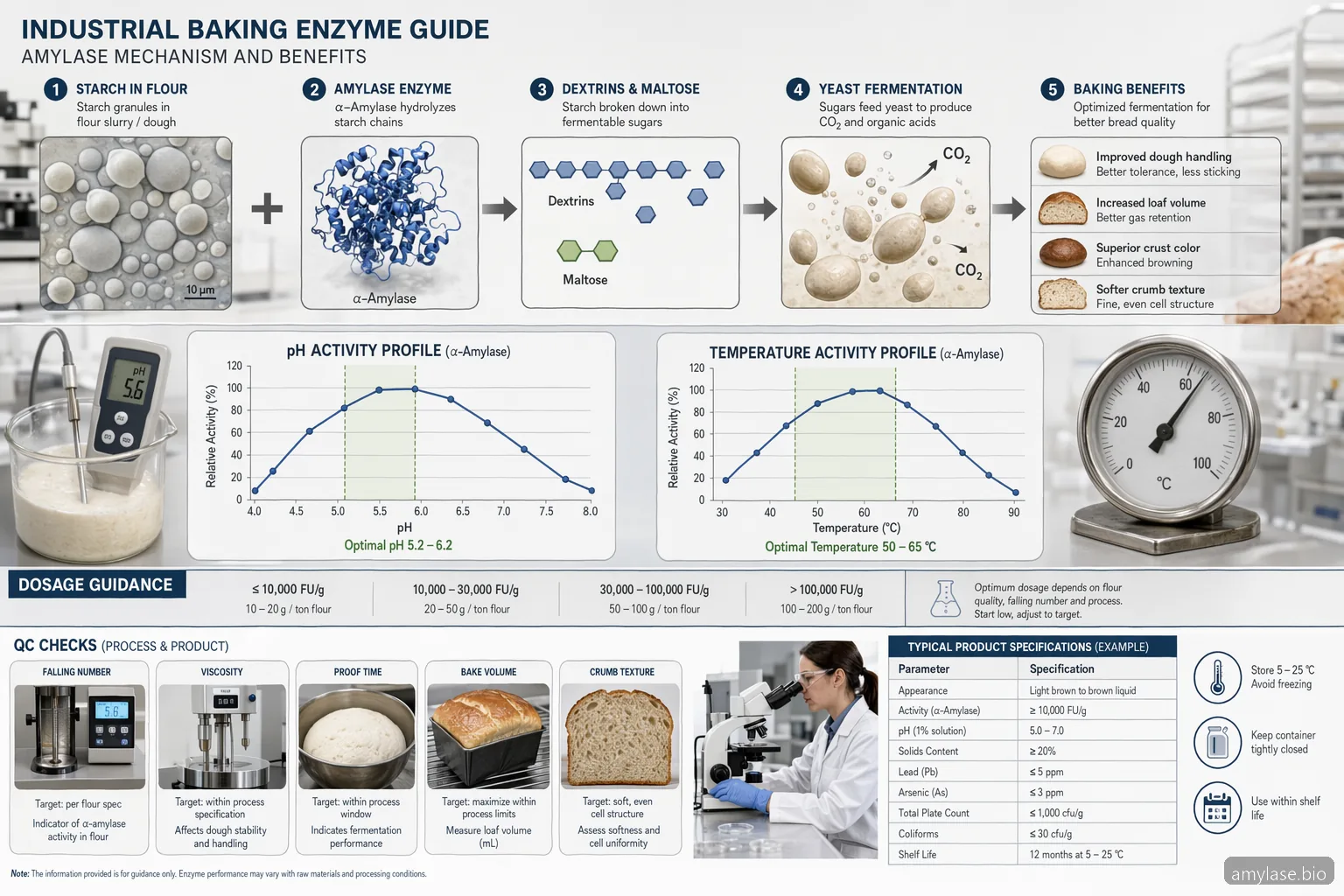
Most bakery doughs operate near pH 5.0 to 6.2 and mix temperatures of 24 to 30°C, with proofing commonly around 30 to 40°C depending on product type. Fungal alpha amylase products often show useful activity in this range and are typically inactivated during baking as crumb temperature rises. Thermostable bacterial amylase may survive longer and should be evaluated carefully where softness extension is desired, because excess residual activity can damage crumb structure. Dosage must be tied to the supplier activity unit and product concentration. As a starting screening band, many concentrated baking amylase preparations are trialed at about 5 to 50 g per 100 kg flour, while diluted improver blends may require higher inclusion. Always confirm with the TDS and pilot baking data. Adjust dosage against flour falling number, dough absorption, fermentation time, sugar level, and final crumb target.
Typical dough pH: 5.0-6.2 • Typical dough temperature: 24-30°C • Typical proofing range: 30-40°C • Screening dosage: often 5-50 g per 100 kg flour, activity dependent
QC Checks for Industrial Baking Trials
A reliable amylase supplier should support trials with analytical and application data, but the bakery should validate performance in its own flour and process. Start with flour quality checks such as falling number, damaged starch, moisture, protein, ash, and farinograph or mixograph behavior. During application trials, record dough temperature, absorption, mixing time, proof height, proof tolerance, dough stickiness, oven spring, loaf volume, crust color, internal crumb structure, sliceability, and shelf-life texture. Where available, RVA or amylograph testing can help identify excessive starch degradation risk. Compare trial loaves against a no-enzyme control and current improver system. Use at least three dosage points to define the working window, not a single pass-fail test. For continuous lines, validate performance over normal flour variation and production speed before full conversion.
Use control, low, target, and high dosage trials • Measure volume, color, crumb, stickiness, and sliceability • Track flour falling number and damaged starch • Validate on production equipment before approval
Supplier Qualification and Documentation
For B2B procurement, supplier qualification is as important as enzyme performance. Request a current COA for each lot, a technical data sheet with activity definition and recommended use range, and an SDS for handling and storage requirements. Confirm product form, carrier, solubility or dispersibility, dusting profile, declared allergens where relevant, shelf life, storage temperature, packaging size, and country of manufacture. Ask how activity is tested, what lot-to-lot tolerance is applied, and whether the same assay is used for release and stability monitoring. If the amylase enzyme will be used in a flour improver, confirm compatibility with oxidants, emulsifiers, ascorbic acid, xylanase, protease, lipase, and other enzymes and amylase systems. Supplier audits should focus on traceability, change notification, contamination control, batch records, and complaint response process.
Require COA, TDS, and SDS • Confirm activity assay and release tolerance • Check carrier, allergens, storage, and shelf life • Assess traceability and change-control process
Cost-in-Use and Scale-Up Decisions
Price per kilogram can be misleading because industrial amylase products differ widely in activity strength, carrier level, stability, and process fit. A lower-priced product may cost more per tonne of flour if the use rate is higher or if it increases rejects. Calculate cost-in-use from delivered price, recommended dosage, activity retention during storage, waste rate, and impact on finished-goods quality. Include operational factors such as dosing accuracy, dust control, premix uniformity, and line downtime caused by sticky dough or off-spec crumb. For scale-up, lock the flour basis dosage, addition point, mixing procedure, and acceptable QC range. Maintain a retained sample from approved lots and review COA values against incoming performance. The best amylase supplier is the one that provides consistent enzyme activity, clear documentation, responsive technical support, and predictable bakery economics.
Compare cost per tonne of flour treated • Include reject reduction and processing stability • Confirm dosing accuracy in plant conditions • Approve only after pilot and production validation
Technical Buying Checklist
Buyer Questions
Yes. Is amylase an enzyme? In baking, amylase is an enzyme that breaks starch into smaller sugars and dextrins. This supports yeast fermentation, crust browning, loaf volume, and crumb softness. Industrial buyers should evaluate enzyme type, activity unit, dosage range, pH and temperature profile, documentation, and pilot bakery results before changing a production formula.
What is the substrate of the enzyme amylase? In bakery systems, the main substrate is starch, especially damaged starch in flour that is more accessible to enzymatic hydrolysis. Amylase acts on starch chains to generate dextrins and fermentable sugars. The practical result depends on flour quality, water absorption, proof time, dough pH, temperature, and the selected alpha amylase enzyme dosage.
Choose an amylase supplier by combining technical validation and procurement controls. Request COA, TDS, SDS, activity assay details, recommended dosage, storage conditions, shelf life, carrier information, and lot-to-lot consistency data. Then run pilot trials against your flour, formula, and line conditions. Final approval should consider cost-in-use, product quality, complaint response, supply continuity, and change notification.
A practical screening range for many concentrated amylase enzyme for baking products is about 5 to 50 g per 100 kg flour, but the correct dose depends on activity strength and flour characteristics. Use the supplier TDS as the starting point. Trial at least three dosage levels and measure dough stickiness, proof response, loaf volume, crust color, crumb texture, and sliceability.
The small intestine produces amylase protease and which other enzyme is a digestive biology question; lipase is commonly discussed alongside amylase and protease. For industrial baking, however, an amylase digestive enzyme is not the purchasing category. Bakeries should source food-processing or baking-grade enzyme amylase with relevant COA, TDS, SDS, activity data, and application support for flour systems.
Amylase (General-Purpose)
ISO 9001 · Food Grade · HALAL · KOSHER
Frequently Asked Questions
Is amylase an enzyme used in baking?
Yes. Is amylase an enzyme? In baking, amylase is an enzyme that breaks starch into smaller sugars and dextrins. This supports yeast fermentation, crust browning, loaf volume, and crumb softness. Industrial buyers should evaluate enzyme type, activity unit, dosage range, pH and temperature profile, documentation, and pilot bakery results before changing a production formula.
What is the substrate of the enzyme amylase?
What is the substrate of the enzyme amylase? In bakery systems, the main substrate is starch, especially damaged starch in flour that is more accessible to enzymatic hydrolysis. Amylase acts on starch chains to generate dextrins and fermentable sugars. The practical result depends on flour quality, water absorption, proof time, dough pH, temperature, and the selected alpha amylase enzyme dosage.
How should an industrial bakery choose an amylase supplier?
Choose an amylase supplier by combining technical validation and procurement controls. Request COA, TDS, SDS, activity assay details, recommended dosage, storage conditions, shelf life, carrier information, and lot-to-lot consistency data. Then run pilot trials against your flour, formula, and line conditions. Final approval should consider cost-in-use, product quality, complaint response, supply continuity, and change notification.
What dosage of amylase enzyme for baking should we start with?
A practical screening range for many concentrated amylase enzyme for baking products is about 5 to 50 g per 100 kg flour, but the correct dose depends on activity strength and flour characteristics. Use the supplier TDS as the starting point. Trial at least three dosage levels and measure dough stickiness, proof response, loaf volume, crust color, crumb texture, and sliceability.
Related: Buy Alpha Amylase for Baking Operations
Turn This Guide Into a Supplier Brief Request a baking amylase specification review, sample, and pilot trial plan for your flour system. See our application page for Buy Alpha Amylase for Baking Operations at /applications/buy-alpha-amylase-baking-procurement/ for specs, MOQ, and a free 50 g sample.
Contact →