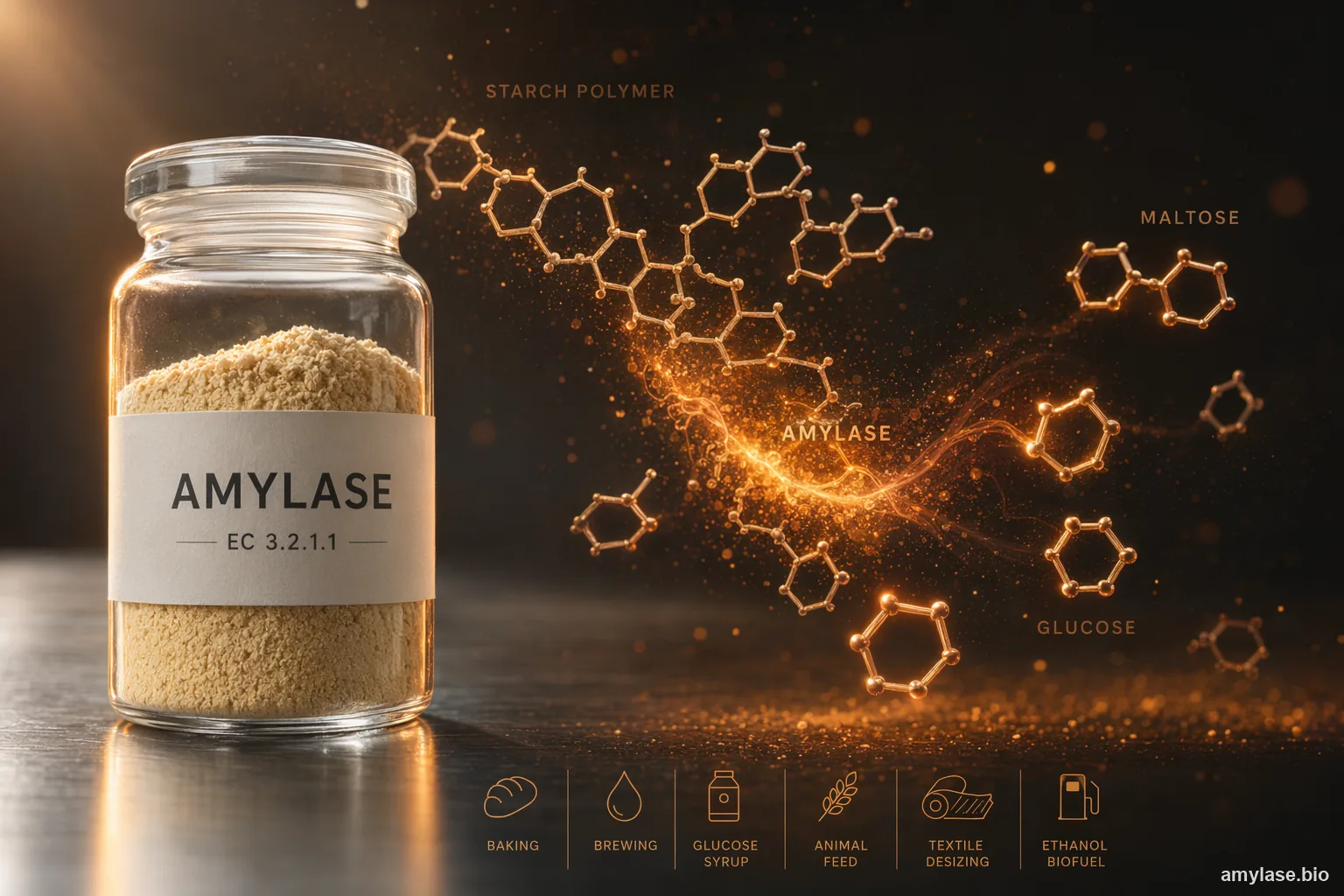
Amylase Enzyme for Brewing: Practical Selection and Process Guide
Select industrial amylase enzyme for brewing with dosage, pH, temperature, QC, COA/TDS/SDS, pilot validation, and supplier checks.
Industrial breweries use amylase to convert starch into fermentable sugars, stabilize extract yield, and improve process control across adjunct, high-gravity, and specialty beer production.
Where Amylase Fits in Brewing
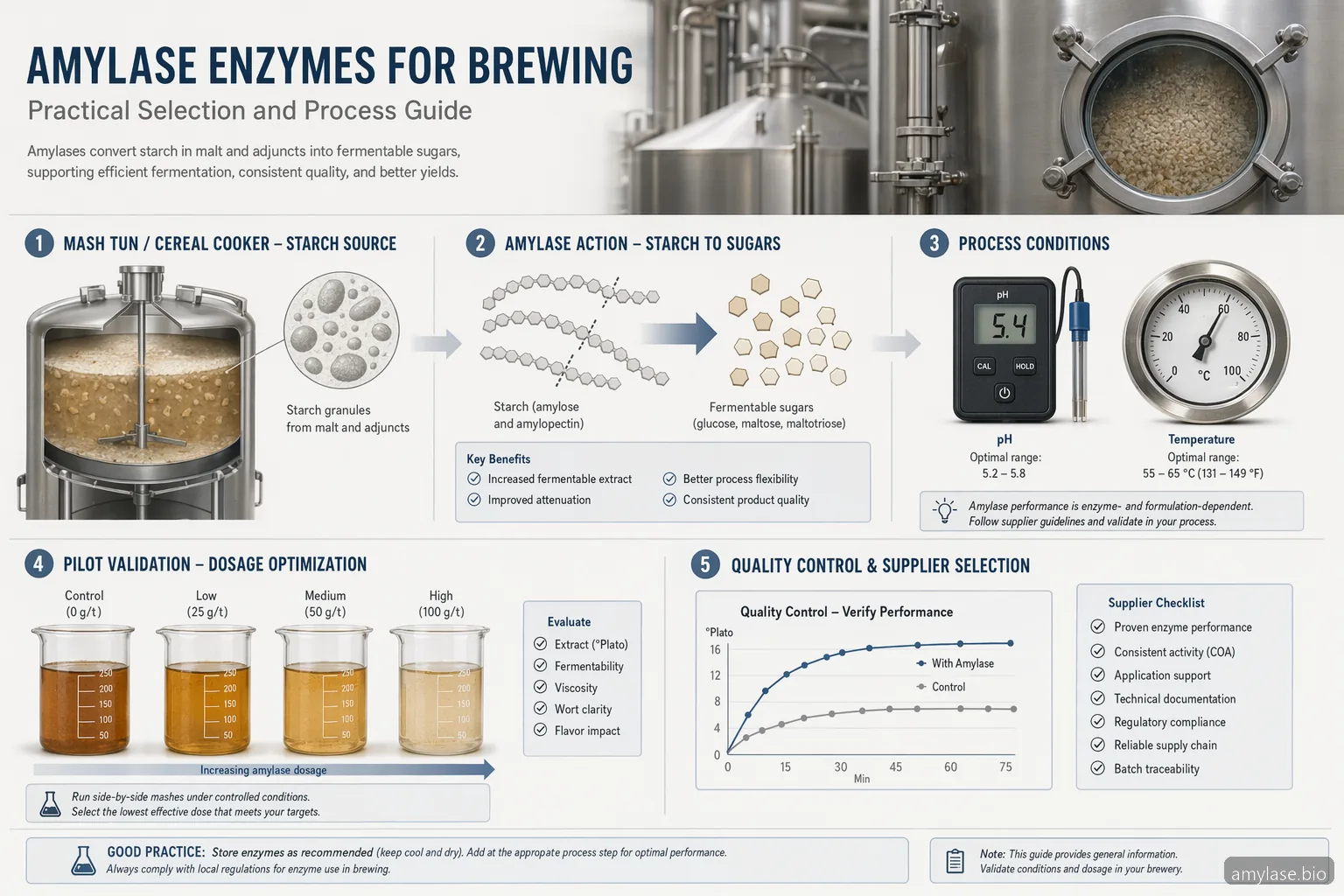
Amylase enzyme for brewing is used to hydrolyze starch from malted barley, raw barley, corn, rice, wheat, sorghum, or other adjuncts into dextrins, maltose, glucose, and other fermentable carbohydrates. In an all-malt mash, malt supplies native enzymes, but supplemental enzyme amylase may be specified when adjunct levels are high, malt diastatic power is variable, or the brewer needs a tighter fermentability window. Alpha amylase enzyme primarily breaks internal alpha-1,4 glycosidic bonds, reducing viscosity and generating shorter dextrins. Glucoamylase can further release glucose from dextrins and is often used when very high attenuation is desired. For B2B purchasing, the target is not simply maximum activity; it is predictable performance under the brewery’s real pH, temperature, mash thickness, grist profile, and residence time.
Best fit: adjunct brewing, high-gravity brewing, dry beer profiles, and extract optimization. • Typical decision drivers: yield, attenuation, viscosity, filtration rate, and flavor neutrality. • Confirm whether the product is alpha-amylase, glucoamylase, or a blended enzyme system.
Process Conditions: pH, Temperature, and Addition Point
Process conditions depend on the enzyme source and formulation, so the supplier’s TDS should always govern final setpoints. As a practical screening range, many brewing alpha-amylases operate around pH 5.2 to 6.0, with fungal products often used near 50 to 65°C and thermostable bacterial alpha-amylases used at higher liquefaction temperatures, commonly 75 to 95°C in adjunct cookers. Glucoamylase is often evaluated around pH 4.0 to 5.0 and 55 to 65°C, depending on the product. Addition can occur in the cereal cooker, mash mixer, saccharification rest, or in a controlled wort treatment step, but carryover into fermentation should be considered. Avoid assuming that more enzyme is better; overdosing can change fermentability, body, foam perception, and residual carbohydrate profile.
Check mash pH before dosing; enzyme activity can fall sharply outside the recommended band. • Use calibrated temperature probes because localized overheating may deactivate proteins. • Match the enzyme to residence time, not only to peak activity temperature.
Dosage Development and Pilot Validation
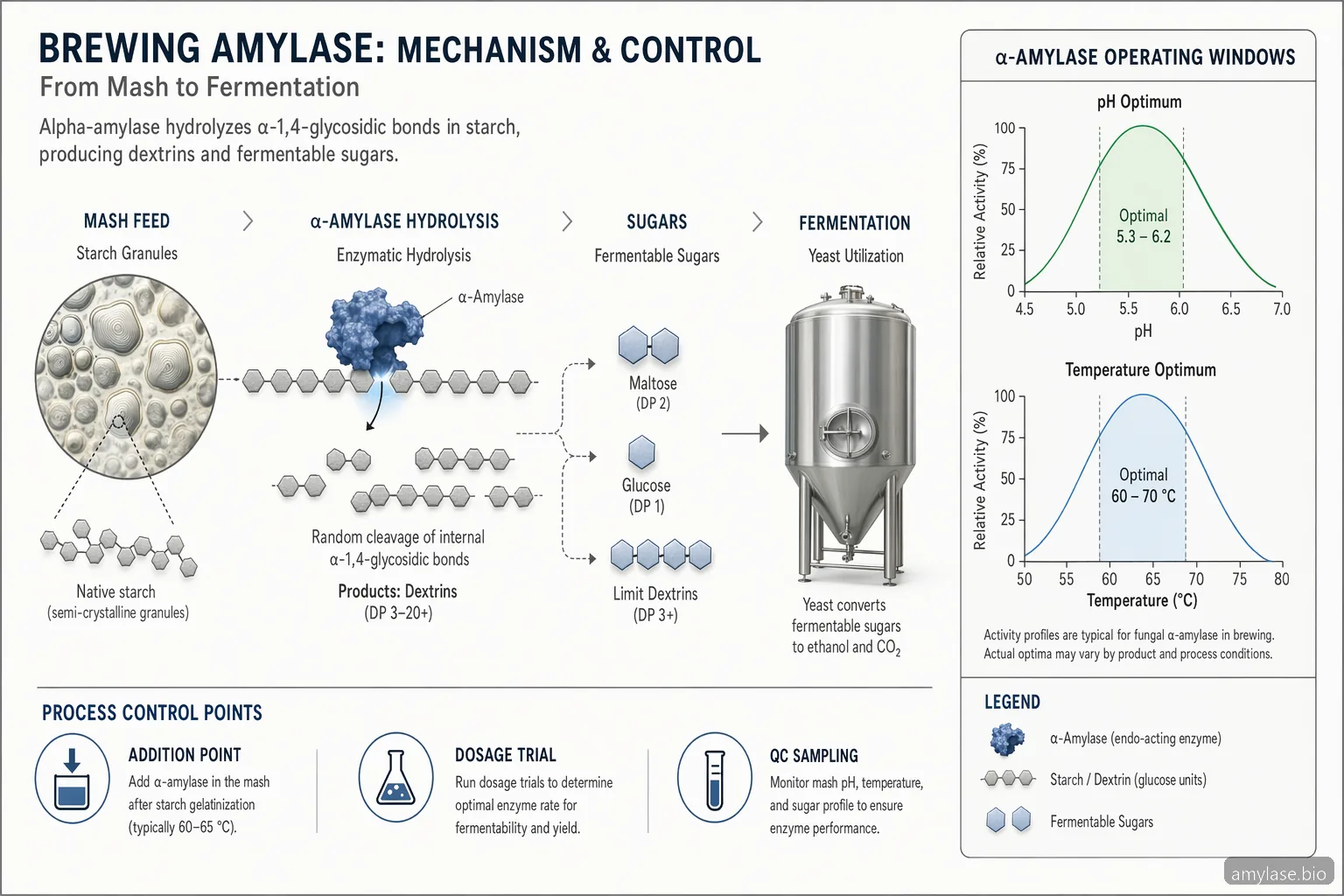
Commercial dosage bands are product-specific because activity units and formulation strength vary by supplier. For early trials, breweries often screen a broad range such as 50 to 500 g per metric ton of grist for concentrated liquid or granular products, then refine based on the actual activity unit stated on the COA. A structured pilot should compare the current process against at least three dosage levels using the same malt lot, adjunct ratio, mash thickness, time-temperature profile, and lauter conditions. Measure extract, apparent attenuation limit, wort viscosity, iodine conversion, filtration time, and fermentation kinetics. Cost-in-use should include enzyme spend, extract recovery, brewhouse throughput, energy requirements, potential cycle-time reduction, and any downstream impact on beer specifications.
Run a no-enzyme control and a current-process benchmark. • Track results by activity units, not only by kilograms of product. • Do not approve scale-up until sensory and fermentation data are reviewed.
Quality Control Checks for Brewery Trials
A brewing trial should translate enzyme activity into brewery-relevant QC results. Iodine staining confirms starch conversion but does not fully describe fermentability, so it should be paired with original gravity, real extract, apparent attenuation limit, and carbohydrate profile where available. Wort viscosity and lauter or filter performance are important when adjuncts or high-gravity mashes are used. The brewer should also monitor pH drift, turbidity, soluble nitrogen context, foam-related observations, and any unexpected flavor changes. If the amylase enzyme is added after boiling or at lower-temperature steps, confirm whether residual activity may continue to change carbohydrate composition. For packaged beer, stability testing and sensory review are essential before routine use.
Core QC: iodine test, gravity, pH, viscosity, attenuation, and fermentation rate. • Advanced QC: HPLC carbohydrate profile and forced-aging sensory checks. • Document lot number, dose, hold time, temperature, and addition point.
Supplier Qualification for Industrial Amylase
An amylase supplier should be evaluated on technical fit, documentation, supply reliability, and support during validation. Request a current COA for each lot, a TDS describing activity units and recommended conditions, and an SDS for handling, storage, and occupational safety controls. Ask how activity is measured, what carriers or stabilizers are present, how shelf life is defined, and what storage temperature is required. For industrial amylase used in brewing, supplier qualification should also include sample availability, lead time, packaging compatibility, traceability, change-notification practices, and technical support for pilot design. Avoid purchasing on headline activity alone; two products with similar labels may behave differently in real wort because of pH tolerance, thermal stability, formulation, and side activities.
Required documents: COA, TDS, SDS, and activity assay description. • Commercial checks: MOQ, lead time, packaging size, and storage requirements. • Technical checks: pH profile, temperature profile, side activities, and deactivation guidance.
Technical Buying Checklist
Buyer Questions
Yes. Amylase is an enzyme that breaks starch into smaller carbohydrates during mashing or adjunct processing. In brewing, the relevant question is which amylase enzyme fits the process: alpha-amylase for liquefaction and dextrin reduction, glucoamylase for more complete conversion toward glucose, or a blend. Selection should be based on pH, temperature, substrate, fermentability target, and validated trial data.
The main substrate of the enzyme amylase is starch, including gelatinized starch from malt and adjunct grains such as corn, rice, wheat, barley, or sorghum. Amylase acts on alpha-linked glucose polymers, producing dextrins and fermentable sugars depending on enzyme type and process conditions. Because starch accessibility changes with milling, gelatinization, mash thickness, and temperature, substrate preparation strongly affects performance.
Compare suppliers by more than price per kilogram. Ask for COA, TDS, SDS, activity units, activity assay method, storage conditions, shelf life, lot traceability, and technical support. Then run pilot mashes using identical grist and process conditions. The winning product should show the best cost-in-use, not just the highest activity claim, by improving extract, attenuation control, filtration, or cycle time without quality issues.
In some adjunct-heavy or specialty processes, external amylase can provide substantial starch conversion support, but it should not be treated as a simple one-for-one replacement without formulation work. Malt contributes flavor, color, nitrogen, minerals, endogenous enzymes, and processing behavior. If the goal is to reduce malt usage or manage variable malt quality, validate extract, FAN context, fermentability, filtration, foam, and sensory outcomes.
Only at a basic biochemical level. Amylase digestive enzyme discussions explain that starch is hydrolyzed by amylase, and educational questions such as “the small intestine produces amylase protease and which other enzyme” usually refer to human digestion and lipase. Industrial brewing decisions are different: buyers need enzyme activity data, process pH and temperature fit, safety documents, pilot validation, and supply qualification.
Amylase (General-Purpose)
ISO 9001 · Food Grade · HALAL · KOSHER
Frequently Asked Questions
Is amylase an enzyme used in brewing?
Yes. Amylase is an enzyme that breaks starch into smaller carbohydrates during mashing or adjunct processing. In brewing, the relevant question is which amylase enzyme fits the process: alpha-amylase for liquefaction and dextrin reduction, glucoamylase for more complete conversion toward glucose, or a blend. Selection should be based on pH, temperature, substrate, fermentability target, and validated trial data.
What is the substrate of the enzyme amylase in a brewery?
The main substrate of the enzyme amylase is starch, including gelatinized starch from malt and adjunct grains such as corn, rice, wheat, barley, or sorghum. Amylase acts on alpha-linked glucose polymers, producing dextrins and fermentable sugars depending on enzyme type and process conditions. Because starch accessibility changes with milling, gelatinization, mash thickness, and temperature, substrate preparation strongly affects performance.
How should a brewery compare amylase suppliers?
Compare suppliers by more than price per kilogram. Ask for COA, TDS, SDS, activity units, activity assay method, storage conditions, shelf life, lot traceability, and technical support. Then run pilot mashes using identical grist and process conditions. The winning product should show the best cost-in-use, not just the highest activity claim, by improving extract, attenuation control, filtration, or cycle time without quality issues.
Can brewing amylase replace malt enzymes completely?
In some adjunct-heavy or specialty processes, external amylase can provide substantial starch conversion support, but it should not be treated as a simple one-for-one replacement without formulation work. Malt contributes flavor, color, nitrogen, minerals, endogenous enzymes, and processing behavior. If the goal is to reduce malt usage or manage variable malt quality, validate extract, FAN context, fermentability, filtration, foam, and sensory outcomes.
Related: Amylase Enzyme for Adjunct Brewing Mash Conversion
Turn This Guide Into a Supplier Brief Request brewing amylase samples, COA/TDS/SDS, and pilot-trial support from amylase.bio. See our application page for Amylase Enzyme for Adjunct Brewing Mash Conversion at /applications/amylase-brewing-mash-conversion/ for specs, MOQ, and a free 50 g sample.
Contact →