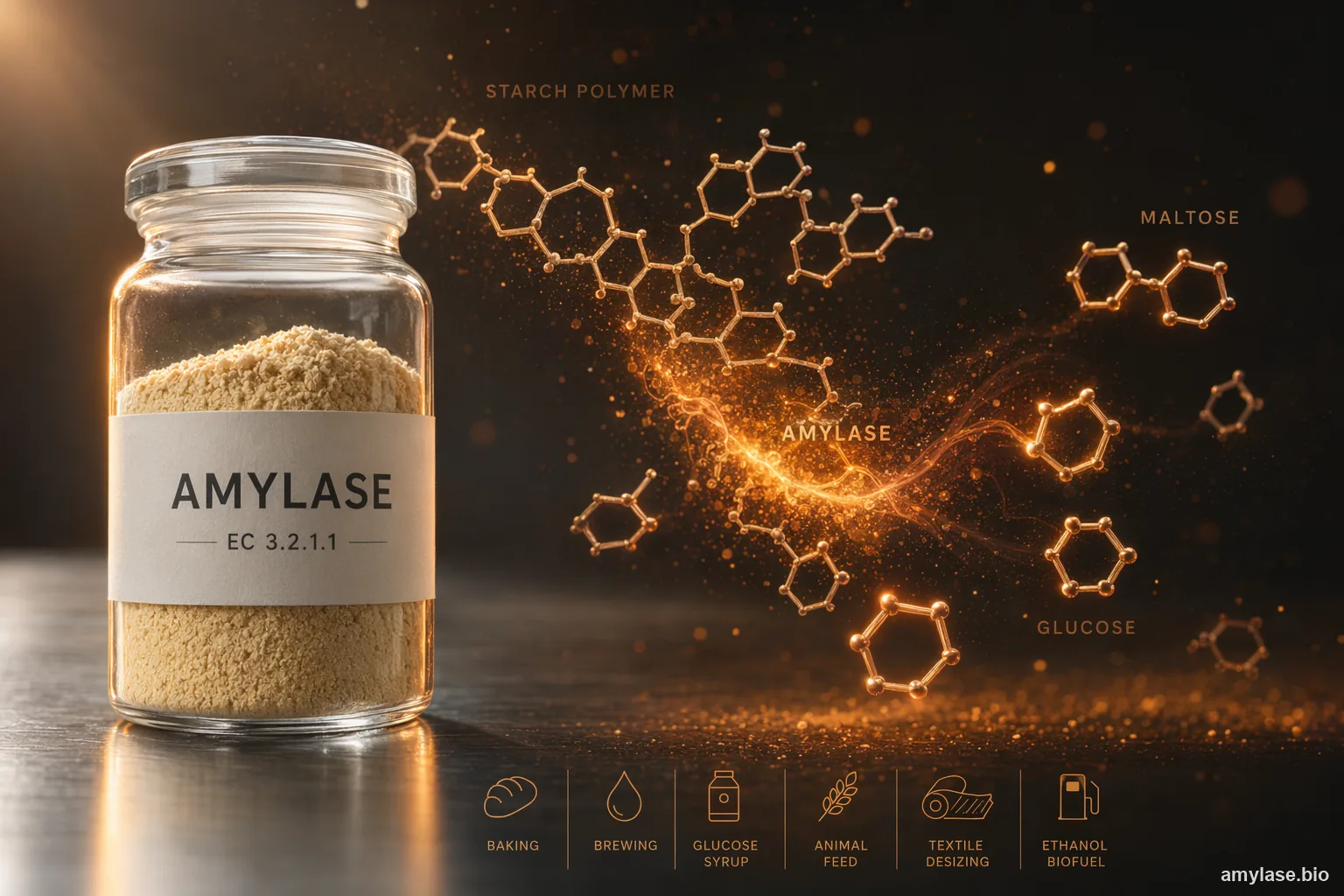
How to Use Amylase Enzyme in Brewing
Practical brewing guidance for amylase enzyme selection, dosage, mash conditions, QC, supplier qualification, and cost-in-use validation.
For breweries using adjuncts, high-gravity mashes, or tighter attenuation targets, amylase enzyme can improve starch conversion when it is matched to the grist, process window, and quality specification.
Where amylase fits in a brewing formulation
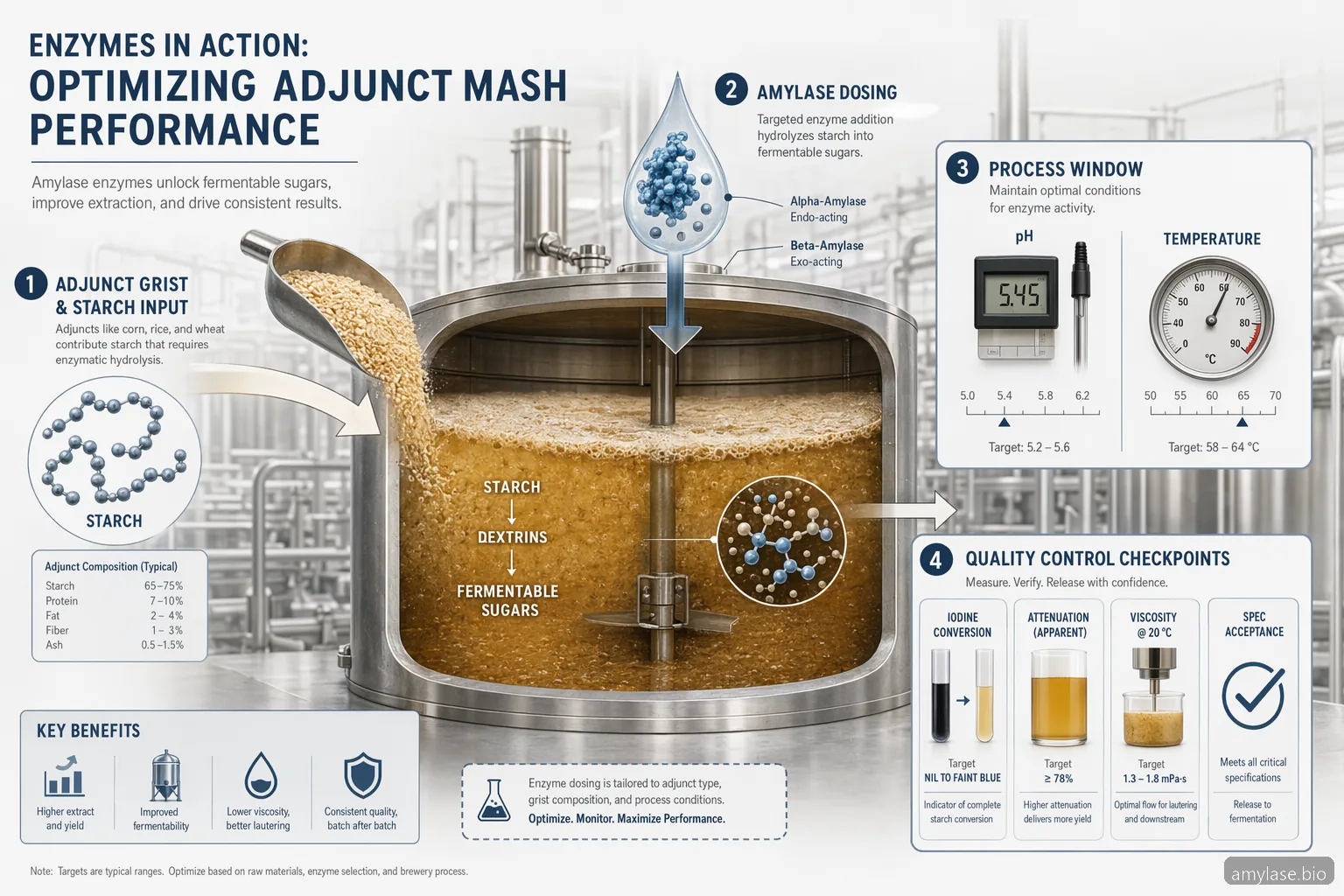
Amylase enzyme is used in brewing to hydrolyze starch into soluble dextrins and fermentable sugars. In all-malt brewing, native malt enzymes often supply enough activity, but industrial amylase becomes valuable when the formulation includes unmalted barley, corn, rice, sorghum, cassava, damaged malt, or very high-gravity mashes. It can also support consistent attenuation when seasonal malt diastatic power varies. The main decision is whether the process needs rapid liquefaction, increased fermentability, lower viscosity, or a specific carbohydrate profile for body and mouthfeel. Alpha amylase enzyme randomly cleaves starch chains to reduce viscosity and create dextrins, while glucoamylase releases glucose from chain ends for higher apparent attenuation. Many breweries validate a combination rather than a single enzyme amylase product. The correct choice depends on grist composition, gelatinization temperature, mash profile, yeast strain, beer style, and downstream filtration requirements.
Use for adjunct-heavy, high-gravity, or variable-malt recipes. • Match the amylase type to the desired sugar spectrum. • Validate against flavor, attenuation, filtration, and foam objectives.
Recommended process conditions for brewing trials
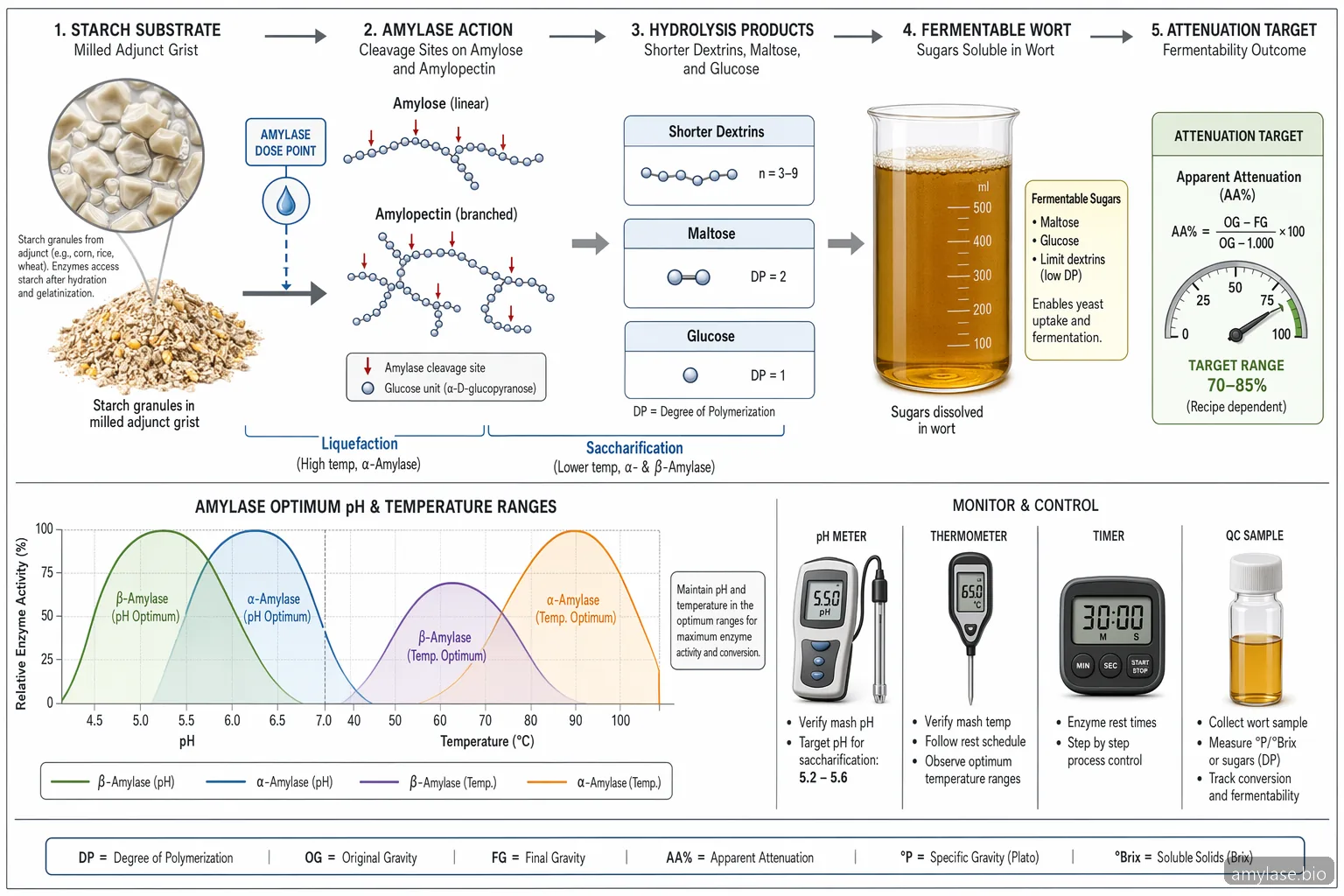
Start with the supplier’s TDS, then run a controlled pilot across two or three dosage levels. For many brewing applications, trial dosages fall around 50-500 g per metric ton of grist, or approximately 0.005-0.05% w/w, depending on declared activity and formulation strength. Mash pH is commonly held near 5.2-5.8, with many amylase products performing well in the 5.0-6.0 range. Fungal alpha amylase often fits 50-60°C mash steps, while thermostable bacterial alpha amylase may be selected for 75-95°C liquefaction in cereal cooking or adjunct processing. Contact time can range from 20-90 minutes, depending on starch load, particle size, and mixing. Avoid assuming that more enzyme is better: overdosing may increase fermentability beyond target, thin body, or change the wort sugar balance. Use the lowest validated dose that meets conversion and sensory requirements.
Pilot at low, medium, and high dosage points. • Keep pH and temperature inside the TDS operating window. • Record grist lot, mash thickness, time, agitation, and extract yield.
Step-by-step use in the brewhouse
For direct mash use, disperse the amylase enzyme into water or wort according to the supplier’s handling guidance, then add it where mixing is strong enough to prevent localized overdosing. In cereal cooking, thermostable enzyme amylase is typically added after pH adjustment and before or during the high-temperature hold, provided the enzyme is designed for that temperature. In infusion or step mashing, addition often occurs near the saccharification rest so the enzyme has sufficient contact time with gelatinized starch. Brewers should confirm whether the product is intended for mash, cereal cooker, or fermentation-side application. If enzyme activity must be stopped, wort boiling usually denatures many amylases, but heat stability varies and must be checked on the TDS. Keep enzyme containers closed, avoid inhalation of dust or aerosols, and follow the SDS for PPE, spill control, and occupational exposure precautions.
Add where mixing is uniform and temperature is controlled. • Do not exceed the supplier’s maximum temperature without validation. • Confirm whether boil, pasteurization, or pH shift deactivates the enzyme.
Quality control checkpoints and acceptance criteria
A practical QC plan links enzyme performance to wort and beer specifications. During mash development, use iodine conversion testing as a fast screen for residual starch, but do not rely on it alone. Track extract yield, original gravity, apparent attenuation limit, viscosity, lautering time, turbidity, and fermentable sugar profile when available. For high-adjunct brewing, HPLC or enzymatic sugar assays can help confirm glucose, maltose, maltotriose, and dextrin changes. In production, compare batches against a control brew and monitor fermentation kinetics, final gravity, alcohol yield, filtration differential pressure, haze stability, and sensory outcomes. Finished beer should meet the same flavor and mouthfeel standards as the non-enzyme formulation unless the project intentionally targets a drier profile. Establish hold points before scale-up: acceptable iodine result, gravity uplift, no abnormal fermentation lag, and no negative sensory drift after packaging stability checks.
Use iodine testing, but confirm with gravity and fermentability data. • Monitor viscosity and lautering performance for adjunct recipes. • Include sensory and shelf-life checks before commercial release.
Supplier qualification and cost-in-use
Industrial amylase procurement should evaluate technical fit and supply reliability, not only price per kilogram. Request a current COA for batch activity and microbiological limits, a TDS for activity units and process window, and an SDS for safe handling. Ask how activity is standardized, what carrier or diluent is used, and whether the product is liquid or powder, since storage, dosing equipment, and operator exposure differ. Confirm recommended shelf life, storage temperature, packaging sizes, lead time, and documentation available for food-processing use in your market. Cost-in-use should be calculated per hectoliter or per metric ton of grist at the validated dose, including yield gains, filtration improvements, reduced rework, inventory handling, and any impact on beer profile. Supplier qualification should include pilot validation, retained samples, batch-to-batch comparison, and a clear change notification process for formulation or activity adjustments.
Request COA, TDS, SDS, sample, and batch traceability details. • Calculate cost per brew, not just enzyme purchase price. • Validate performance with your grist, water, equipment, and yeast.
Technical Buying Checklist
Buyer Questions
Yes. Amylase is an enzyme used by breweries to convert starch into smaller carbohydrates during mash or adjunct processing. In B2B brewing, the question is not simply whether to use amylase, but which amylase enzyme type fits the formulation. Alpha amylase enzyme, glucoamylase, or blends may be selected based on pH, temperature, attenuation, body, and filtration targets.
The main substrate of the enzyme amylase is starch, including amylose and amylopectin from malted grain or adjuncts. Effective conversion requires starch to be accessible, which depends on milling, gelatinization, mash thickness, and temperature. If starch is not gelatinized or well dispersed, even a high-quality industrial amylase may underperform, so process conditions must be validated with the enzyme dose.
Choose alpha amylase when the goal is starch liquefaction, viscosity reduction, or dextrin formation during mash or cereal cooking. Choose glucoamylase when the goal is more complete conversion to glucose and higher attenuation, such as very dry or high-gravity beers. Many formulations use both, but overdosing glucoamylase can reduce body, so pilot trials and sensory checks are essential.
Brewing should use food-processing or industrial brewing enzyme preparations with appropriate documentation, not consumer digestive supplements. An amylase digestive enzyme is formulated for a different use case, dose format, and regulatory pathway. For brewery procurement, request the supplier’s COA, TDS, SDS, storage guidance, and technical support for mash or adjunct-processing trials before considering commercial production.
In human digestion, amylase, protease, and lipase are commonly discussed together, but that topic is separate from brewing formulation. Breweries are concerned with enzymes and amylase performance in grain processing, not medical or supplement advice. For beer production, focus on starch substrate conversion, mash pH, temperature stability, dosage, attenuation target, and documentation from a qualified industrial amylase supplier.
Amylase (General-Purpose)
ISO 9001 · Food Grade · HALAL · KOSHER
Frequently Asked Questions
Is amylase an enzyme used in industrial brewing?
Yes. Amylase is an enzyme used by breweries to convert starch into smaller carbohydrates during mash or adjunct processing. In B2B brewing, the question is not simply whether to use amylase, but which amylase enzyme type fits the formulation. Alpha amylase enzyme, glucoamylase, or blends may be selected based on pH, temperature, attenuation, body, and filtration targets.
What is the substrate of the enzyme amylase in beer production?
The main substrate of the enzyme amylase is starch, including amylose and amylopectin from malted grain or adjuncts. Effective conversion requires starch to be accessible, which depends on milling, gelatinization, mash thickness, and temperature. If starch is not gelatinized or well dispersed, even a high-quality industrial amylase may underperform, so process conditions must be validated with the enzyme dose.
How do I choose between alpha amylase and glucoamylase?
Choose alpha amylase when the goal is starch liquefaction, viscosity reduction, or dextrin formation during mash or cereal cooking. Choose glucoamylase when the goal is more complete conversion to glucose and higher attenuation, such as very dry or high-gravity beers. Many formulations use both, but overdosing glucoamylase can reduce body, so pilot trials and sensory checks are essential.
Can the same amylase digestive enzyme be used in a brewhouse?
Brewing should use food-processing or industrial brewing enzyme preparations with appropriate documentation, not consumer digestive supplements. An amylase digestive enzyme is formulated for a different use case, dose format, and regulatory pathway. For brewery procurement, request the supplier’s COA, TDS, SDS, storage guidance, and technical support for mash or adjunct-processing trials before considering commercial production.
Related: Amylase Enzyme for Adjunct Brewing Mash Conversion
Turn This Guide Into a Supplier Brief Request amylase samples, COA/TDS/SDS, and pilot-scale dosing support for your brewing formulation. See our application page for Amylase Enzyme for Adjunct Brewing Mash Conversion at /applications/amylase-brewing-mash-conversion/ for specs, MOQ, and a free 50 g sample.
Contact →